BJP Roars in Bengal: Biggest Political Shake-Up in Years Rocks State
Alekhya Kota - MAY 4, 2026
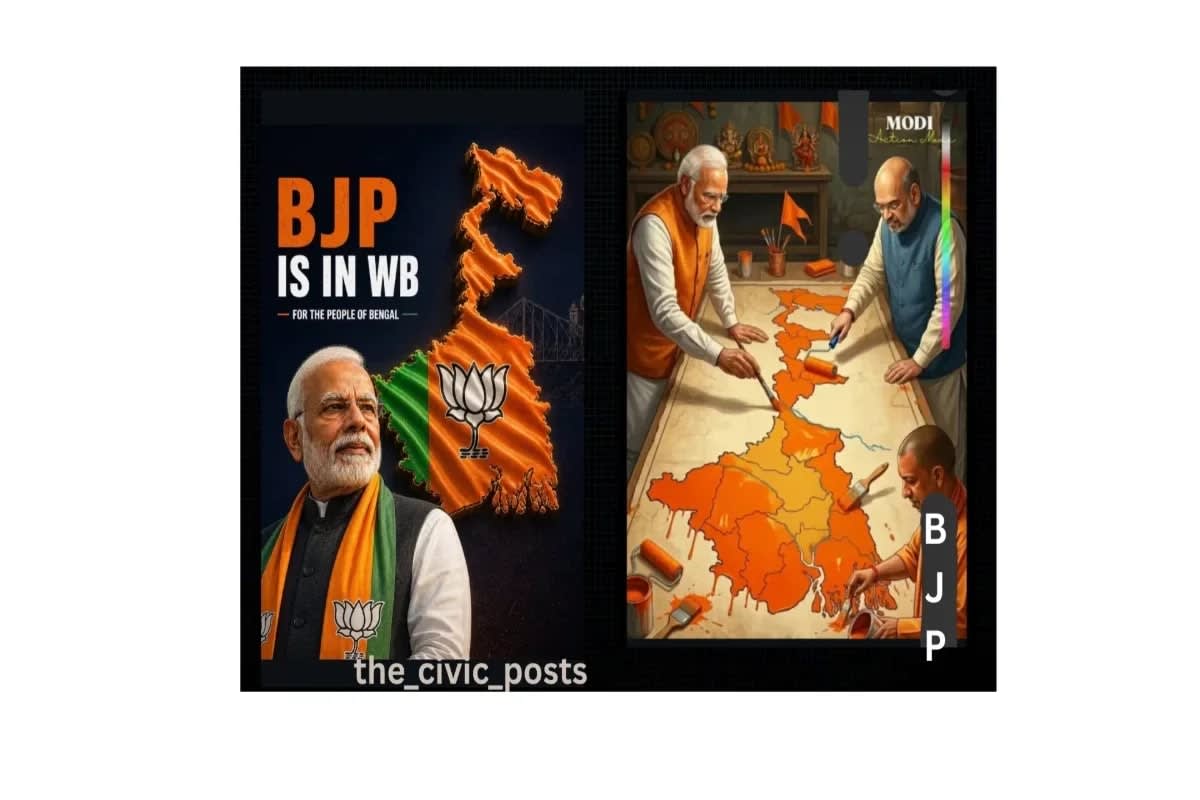
West Bengal’s political landscape appears to be witnessing a dramatic and unforgettable turning point, as early trends and strong wave-like support indicate a major victory surge for the Bharatiya Janata Party (BJP), leaving the Trinamool Congress (TMC) struggling to maintain its long-held dominance. What is unfolding is not just an electoral result-it feels like a complete rewriting of the state’s political script.
For years, West Bengal has been strongly associated with the influence of the TMC, which built its presence through deep grassroots networks, welfare-driven governance, and strong regional identity. The party’s hold over the state was considered firm and resilient, shaped by years of political consolidation and voter trust. However, the current wave suggests that that long-standing equation is being seriously challenged in a way few had anticipated.
The BJP’s rise in this scenario reflects a sharp shift in voter mood. Across multiple regions, there appears to be a strong undercurrent of change, where voters are expressing a desire for a new direction, new leadership style, and different governance priorities. This change is not limited to one region or community-it is visible as a broader pattern cutting across urban centers, semi-urban belts, and even rural pockets.
What makes this shift more striking is the intensity of the political swing. Instead of a gradual change, the momentum feels sudden and forceful, like a wave reshaping the entire shoreline of Bengal politics. Constituencies that were once considered strongholds are now showing unexpected results, signaling that voter sentiment has moved beyond traditional loyalties.
At the heart of this transformation lies a mix of factors. Development expectations, employment concerns, governance satisfaction, and political messaging have all played a role in influencing public opinion. Many voters seem to be evaluating not just legacy, but also future promise-what a party can deliver in the coming years rather than what it has done in the past.
The BJP’s campaign narrative appears to have tapped into this evolving mindset effectively. Its messaging around change, development, and stronger administrative alignment has resonated with a significant section of the electorate. This has translated into visible gains on the ground, converting political momentum into electoral advantage.
On the other hand, the TMC faces one of its toughest political moments. A party that once enjoyed strong emotional and organizational connect with voters now finds itself under pressure to reassess its strategy and reconnect with shifting public expectations. The challenge is not just about numbers-it is about understanding why voter sentiment has moved and how that connection can be rebuilt.
Political observers describe this moment as a “sentiment realignment,” where voters are no longer bound strictly by past loyalties but are increasingly open to change based on current expectations. This makes the outcome not just an electoral story, but also a reflection of evolving democratic behavior in the state.
The scale of the BJP’s performance in this scenario suggests more than just an electoral win-it signals a structural change in West Bengal’s political competition. The traditional bipolar framework is being redefined, and the balance of power is undergoing a visible shift.
If this trend continues through final results, it would mark one of the most significant political transitions in recent years in the state. A new chapter could begin, where governance priorities, political strategies, and voter expectations all enter a redefined space.
Yet, in politics, momentum is never static. Final outcomes, post-result strategies, and governance performance will determine how long this shift sustains. What is clear for now is that West Bengal is experiencing a powerful political wave-one that has brought the BJP into a commanding position while pushing the TMC into a period of deep reflection and recalibration.
In essence, this is more than an election update. It is a moment that signals change, challenges legacy, and reshapes the very narrative of West Bengal’s political future.