Delimitation Battle Intensifies in Tamil Nadu as DMK Skips Vijay’s MPs Meet
Alekhya Kota - AUG 8, 2026

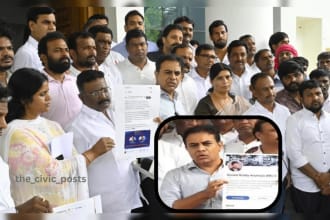
The political climate in Tamil Nadu has once again intensified dramatically following a high-profile legislative consultation convened by Chief Minister C. Joseph Vijay to deliberate on the controversial national delimitation framework. The meeting, hosted at the iconic Kalaivanar Arangam in Chennai, was envisioned by the ruling administration as a crucial platform to forge a cohesive, cross-party consensus among all Members of Parliament representing the state.
The primary objective was to present a united front against any prospective policy changes at the federal level that might dilute the relative legislative strength and proportional parliamentary representation of southern states. However, rather than projecting a picture of absolute state solidarity, the initiative encountered a profound setback when the state's dominant political forces, spearheaded by the Dravida Munnetra Kazhagam alongside the principal opposition party, the All India Anna Dravida Munnetra Kazhagam, announced a decisive boycott of the proceedings.
This unexpected friction laid bare the deep-seated structural divisions that continue to shape the regional political landscape, converting what was meant to be a collaborative strategy session into an arena for fierce partisan posturing. Out of the total fifty-seven parliamentarians representing Tamil Nadu across both houses of Parliament, only a minority of twenty legislators chose to attend the deliberations.
The remaining thirty-seven members, including the entire contingent from the ruling DMK and the AIADMK, completely stayed away from the venue. This muted turnout sent a powerful signal regarding the lack of uniform political alignment behind the Chief Minister's initiative, illustrating that deep historical rivalries and strategic disagreements frequently supersede broader state-level objectives when executive approaches are perceived as unilateral or politically motivated.
The root of the ongoing debate lies in the complex national discussions surrounding the proposed delimitation of parliamentary constituencies. Across the political spectrum in Tamil Nadu, there has long been a shared apprehension that any redrawing of electoral boundaries based primarily on recent population metrics would heavily penalize states that have successfully implemented effective population control measures and achieved significant socio-economic progress over the past several decades.
Projections and demographic analyses frequently suggest that if current formulas are applied without adequate constitutional protections, southern states like Tamil Nadu could witness a significant decline in their relative share of Lok Sabha seats, thereby diminishing their political influence and bargaining power within the national parliament. Recognizing the existential nature of this challenge, previous administrations had also raised sharp concerns and coordinated joint regional platforms with neighboring states to demand permanent constitutional safeguards that preserve southern representation.
Despite this foundational agreement on the dangers of unfair delimitation, the decision by the DMK and other major regional players to boycott the Chennai meeting was driven by tactical grievances and competing legislative priorities. Senior leaders of the primary opposition bloc openly criticized the government's approach, characterizing the urgent consultative meeting as a political maneuver designed to deflect public focus from pressing regional and agrarian crises.
Specifically, the DMK leadership argued that while the administration was eager to host discussions on national parliamentary restructuring, it remained conspicuously silent on critical inter-state water disputes, most notably the contentious Mekedatu dam project proposed by neighboring Karnataka and the broader Cauvery water-sharing impasse.
Insisting that the protection of local agricultural rights and river waters must take immediate precedence, the opposition laid down strict conditions, maintaining that they would only participate in deliberations if the state government demonstrated an equivalent level of urgency toward convening a dedicated all-party platform to address the Cauvery and Mekedatu controversies.
Furthermore, the critique from the opposition extended beyond substantive policy issues to encompass questions of political protocol and institutional hierarchy. Leaders of the principal opposition faction likened the Chief Minister's direct outreach to individual parliamentarians to an irregular administrative maneuver that bypassed established organizational channels and party structures.
They argued that elected lawmakers function under collective party discipline and state-level directives, making a direct executive appeal to individual legislators redundant when official stances had already been formally established in previous multi-party assemblies.
This procedural objection highlighted the underlying struggle for narrative control within the state, as established political entities sought to demonstrate that a relatively newer governing formation cannot simply dictate the terms of regional advocacy without engaging in formal, peer-to-peer political dialogue with veteran leaders.
As a consequence of the boycott, the gathering at Kalaivanar Arangam proceeded primarily with the participation of legislators affiliated with the Congress party, the Viduthalai Chiruthaigal Katchi, various communist factions, and other smaller regional allies. While these attendees represented a dedicated bloc willing to endorse resolutions opposing any reduction in southern parliamentary weight, the absence of the state's dominant political heavyweights stripped the meeting of its intended weight as an all-encompassing statewide mandate.
For the ruling administration, this outcome presents a delicate governance challenge, underscoring the difficulties of navigating a complex coalition environment while trying to establish leadership on pan-southern issues that resonate deeply with the local populace. The inability to bring rival parties to the same table emphasizes that regional unity in Tamil Nadu remains perpetually fragile, constrained by decades of intense electoral competition and strategic posturing.
Looking ahead, the fallout from this skipped consultation highlights the intricate dynamics that will define the state's political discourse as national legislative sessions approach. With federal discussions regarding constituency boundary adjustments and potential seating expansions remaining a focal point of national policy, all regional stakeholders find themselves walking a careful tightrope between defending long-term federal rights and managing immediate electoral positioning.
Whether the governing administration can recalibrate its outreach methodology or whether the opposition will continue to prioritize regional irrigation grievances over national delimitation remains one of the most compelling questions shaping the state's future trajectory.
Ultimately, the events in Chennai serve as a striking reminder that safeguarding regional interests requires not only a shared understanding of external threats but also an extraordinary degree of internal political consensus and transparent communication among all segments of the state's leadership.