Mekedatu Row: CM Vijay Says Politics Won’t Solve Cauvery Crisis
Alekhya Kota - AUG 7, 2026

The long-running Cauvery water dispute between Tamil Nadu and Karnataka has once again emerged as a major political flashpoint in southern India. The disagreement, which has for decades combined questions of water availability, agriculture, federal relations and regional politics, has taken a fresh political turn following renewed concerns over Karnataka’s proposed Mekedatu project and the management of water during deficit periods.
The latest controversy has placed the Tamil Nadu government under pressure from opposition parties, which have demanded an all-party meeting to discuss the state’s strategy on the Cauvery issue. The government, however, has rejected the demand, arguing that its position on the river dispute is already clear and that the administration is pursuing the necessary legal, political and institutional channels to protect Tamil Nadu’s interests.
Addressing the issue in the legislative Assembly, Chief Minister C. Joseph Vijay adopted a firm position against what he described as political attempts to gain mileage from an issue directly connected with the livelihood of farmers. He maintained that Tamil Nadu would not compromise on its legitimate share of Cauvery water and said the government was fully aware of the steps required to safeguard the state’s interests.
The disagreement comes at a time when concerns over water availability have become particularly important for agricultural communities. Farmers in several parts of Tamil Nadu depend heavily on Cauvery flows for irrigation, especially during critical cultivation periods. Any reduction or uncertainty in water releases can therefore have consequences far beyond the political arena, affecting crop planning, farm incomes and rural livelihoods.
The Mekedatu project has added another layer to the dispute. Karnataka has proposed the construction of a balancing reservoir across the Cauvery, with the project being presented as a means of meeting drinking-water and other requirements. Tamil Nadu has consistently opposed the proposal, maintaining that such an upstream project could affect the availability and flow of water to the state.
The latest political confrontation follows attempts by the Tamil Nadu administration to explore dialogue with Karnataka. The government has argued that communication between neighbouring states can sometimes help prevent disputes from escalating further. From this perspective, direct discussions were seen as an opportunity to address water-release concerns and explore possible areas of cooperation while simultaneously conveying Tamil Nadu’s objections to projects that could affect downstream water availability.
The Chief Minister defended the idea of dialogue by pointing out that even parties involved in serious international conflicts sometimes sit across the table to find solutions. According to this argument, neighbouring states within the same country should also be willing to explore discussions when public welfare is involved.
However, the proposed approach has not prevented political criticism. Opposition parties have questioned whether negotiations alone can adequately protect Tamil Nadu’s interests, particularly when the state faces water shortages and farmers are demanding timely releases. They have therefore called for an all-party platform that would allow the government and opposition to formulate a united strategy.
The government’s refusal to convene such a meeting has become another point of political confrontation. The administration has argued that an all-party meeting should not become an opportunity for political parties to compete over who can claim greater credit for protecting the state’s interests. Instead, it has emphasized that the issue requires sustained administrative action, legal intervention and engagement with the appropriate authorities.
The government has also pointed to its communication with the Union government. A detailed representation has reportedly been submitted to Prime Minister Narendra Modi, seeking central intervention on matters concerning the Mekedatu proposal and related decisions. The Tamil Nadu government has maintained that the Centre has an important role to play in ensuring that interstate water disputes are handled within the established legal and regulatory framework.
The Cauvery Water Management Authority and the Supreme Court remain important institutions in the broader dispute. Tamil Nadu has relied on legal and regulatory mechanisms in the past to seek enforcement of water-sharing arrangements and ensure that Karnataka releases the state’s allocated share during periods of distress.
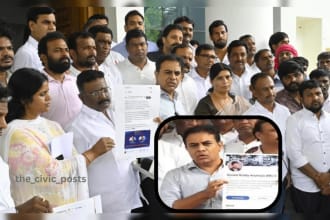
The political battle has also spilled over into protests and law-and-order developments. Demonstrations linked to water shortages and agricultural concerns have intensified the pressure on the government. The detention of an opposition leader during one such protest added another dimension to the controversy, with rival political groups trading accusations over the handling of dissent.
Opposition leaders have alleged that the government is attempting to silence criticism instead of addressing concerns on the ground. The ruling side, however, has maintained that protests and political campaigns should not be allowed to turn a sensitive interstate water issue into a vehicle for partisan confrontation.
At the heart of the debate lies a much larger question: how should interstate water disputes be managed when the interests of two states appear to clash?
For Tamil Nadu, the Cauvery is not merely a river or a legal issue. It is closely connected with agriculture and the economic security of thousands of farming families. Water released through the Cauvery system plays a crucial role in cultivation across the delta regions, making reliable supplies essential for farmers planning their crops.
For Karnataka, meanwhile, growing urban demand, drinking-water requirements and its own agricultural needs remain significant considerations. This competing demand makes the Cauvery dispute particularly difficult to resolve through political statements alone.
The Mekedatu proposal has consequently become symbolic of the wider disagreement. Tamil Nadu fears that additional infrastructure upstream could influence downstream availability, while Karnataka has argued for its own developmental and water-management requirements. Finding common ground between these positions requires more than political rhetoric.
The latest confrontation also demonstrates how interstate resource disputes can quickly become domestic political battles. Whenever water availability declines, opposition parties naturally seek to hold governments accountable, while ruling administrations attempt to demonstrate that they are protecting the state’s interests. In such circumstances, accusations of political opportunism can become almost as intense as the original disagreement over water.
Yet, beyond the political exchanges, the consequences are felt most directly by farmers. A delayed water release can force cultivators to postpone planting, reduce the area under cultivation or reconsider crop choices. In an already challenging agricultural environment, uncertainty over irrigation can create additional financial pressure.
That is why the Tamil Nadu government faces the difficult task of balancing several priorities simultaneously. It must defend the state’s legal entitlement, maintain pressure on the Centre and relevant water-management authorities, communicate with Karnataka where necessary, and reassure farmers that their interests remain protected.
Rejecting an all-party meeting does not necessarily end the political debate. Opposition parties are likely to continue demanding a broader consensus, particularly whenever water shortages become more severe. At the same time, the government will need to demonstrate through concrete action that its existing strategy is producing results.
The Cauvery dispute ultimately cannot be solved through political accusations alone. It requires adherence to legal decisions, transparent water-management mechanisms, scientific assessment of available resources and constructive engagement between the states. Climate variability and changing rainfall patterns are also making water management increasingly complicated, adding urgency to the need for long-term solutions.
As the political confrontation continues, the central challenge remains unchanged: ensuring that farmers receive dependable water while respecting the rights and legitimate requirements of both Karnataka and Tamil Nadu.
The latest Assembly showdown therefore represents more than another episode in an old political dispute. It highlights the continuing difficulty of managing shared natural resources within India’s federal structure. Whether through court intervention, regulatory mechanisms, negotiations or a combination of all three, the focus will ultimately have to return to the same objective-finding a sustainable and legally sound way to manage the Cauvery while protecting the livelihoods that depend on it.
For Tamil Nadu’s government, the immediate political message is one of firmness: the state will continue to defend what it considers its rightful Cauvery share. For the opposition, the demand for a collective political strategy is likely to remain a key issue. And for farmers, the expectation is much simpler-water must reach their fields when they need it most.