Where Is Borugadda Anil? Phone Remains Unreachable
Alekhya Kota - AUG 6, 2026

The landscape of Andhra Pradesh regional politics operates on a hyper-volatile frequency where shifts in executive power invariably trigger intense administrative crackdowns, unexpected legal reckonings, and explosive public fallouts. Few figures embody this chaotic intersection of aggressive political messaging, intense legal vulnerability, and sudden, dramatic invisibility quite like Borugadda Anil Kumar.
The sudden unavailability of Borugadda Anil Kumar unfolded in the immediate wake of his high-profile public protest and fierce verbal attacks against senior YSRCP leadership in Tadepalli. Following his demonstrations outside party quarters and subsequent media interactions, his mobile phones were abruptly switched off, and tracking attempts by news desks-such as live reporting and calling efforts by media anchors like Mahaa Srinivas-confirmed he had become completely unreachable.
Because his disappearance tracking aligns closely with the rapid sequence of political fallout over the first week of August 2026, he has effectively been untraceable and off-grid for roughly 24 to 36 hours. This abrupt radio silence has kept regional news networks and investigative channels gripped with speculation over whether he has gone underground to dodge law enforcement or implemented a tactical self-exile.
Why Is Borugadda Anil Protesting Outside Jagan’s Residence?
Following a series of high-profile public outbursts, open challenges directed at top party echelons, and a dramatic sit-in demonstration outside party headquarters, the controversy escalated exponentially when reports surfaced that Anil Kumar had abruptly vanished from public view, leaving his cellular phones completely switched off and law enforcement agencies scrambling to trace his movements.
To fully grasp the gravity of this unfolding mystery, one must trace the rapid sequence of events that transformed a background political campaigner into a central fixture of state headlines. Over several years, particularly during a prior administrative era marked by heavy political polarization, Anil Kumar functioned as an abrasive defender of the ruling establishment.
He gained notoriety for using sharp, uninhibited rhetoric against prominent opposition leaders, earning him both the protection of partisan networks and a mounting stack of serious criminal charges, extortion allegations, and rowdy-sheet registrations. When political fortunes inverted and a new government took charge, these cumulative legal vulnerabilities caught up with him, plunging his career into a complex web of judicial remands, interim bails, and investigative questioning.
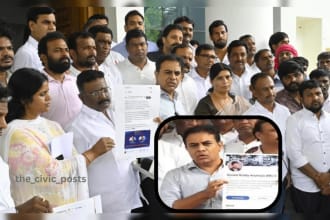
The latest escalation began with a public spectacle that caught both political strategists and news desks completely off guard. Feeling betrayed by what he perceived as systemic abandonment and public distancing by his former political patrons, Anil Kumar staged a dramatic sit-in protest directly outside the YSRCP central headquarters in Tadepalli. Accompanied by his wife, he sat on the pavement under intense media scrutiny, launching blistering verbal attacks against senior party figures, most notably former general secretary Sajjala Ramakrishna Reddy.
His core grievance centered on the acute hypocrisy of a political machine that utilizes aggressive foot soldiers for intense ideological warfare during prosperous tenure periods, only to cast them aside, label them as criminal elements, and refuse basic audience or legal support once they face the wrath of a new regime.
The verbal assault did not remain a localized street protest; it quickly rippled through 24-hour news channels and digital broadcast panels, igniting fierce debates across the state. Prominent media personalities and investigative anchors, such as senior journalist Mahaa Srinivas, brought the immediate aftermath under the microscope during extensive political roundtables.
As newsrooms attempted to verify claims, secure official statements, and track down the explosive allegations regarding behind-the-scenes instructions given during peak campaign cycles, a startling administrative reality emerged: all attempts by media desks and investigative trackers to reach Borugadda Anil Kumar directly were met with complete silence.
His personal cellular lines were switched off, his known residential properties were found locked or deserted, and a profound radio silence descended around his immediate circle.
This sudden disappearance immediately triggered a torrent of conflicting speculations across regional political circles and digital media platforms. Naturally, the primary narrative suggested an urgent, defensive flight from impending legal action or tightened police surveillance.
Given that he has historically faced numerous criminal cases ranging from intimidation and extortion to inflammatory remarks directed at top state dignitaries, investigators and intelligence units treat any abrupt disappearance with high operational priority. Speculation mounted across news bulletins regarding whether he had gone deep underground to evade execution of pending warrants or if he was attempting a tactical self-exile to shield himself from being made a scapegoat in widening institutional inquiries.
Conversely, a secondary, highly charged political theory circulating among analysts suggests that his sudden vanishing act might be linked to the sensitive, potentially explosive insider information he claims to possess. During previous police interrogations and media interactions, figures within his orbit frequently hinted that individuals who operate on the aggressive fringes of political campaigns accumulate detailed knowledge regarding campaign funding streams, backroom operational directives, and internal party coordination.
When such operatives find themselves cornered and subsequently cut off from institutional shelter, their sudden silence or unexpected disappearance creates immense anxiety among mainstream party leadership structures.
The underlying fear across party headquarters is that an untraceable, cornered figure might be positioning himself to leverage his silence or prepare a strategic legal defense that could cause severe public relations damage to his former patrons.
The broader public reaction to Anil Kumar’s disappearance highlights the transient, transactional nature of political patronage in regional dynamics. During periods of administrative dominance, vocal loyalists are often encouraged, shielded from immediate scrutiny, and utilized as blunt instruments to batter political adversaries.
However, once power dynamics shift and legal pressures mount, the protective insulation evaporates overnight. The stark contrast between Anil Kumar’s loud, confrontational demonstrations outside party gates and his current status as an unreachable, untraceable entity serves as a harsh object lesson in the realities of political expendability.
As investigative agencies continue to comb through call data records, monitor potential transit routes, and issue alerts to prevent unauthorized movement, the mystery surrounding Borugadda Anil Kumar continues to grip the public imagination.
Whether his disappearance marks a temporary, calculated retreat to navigate complex legal battles or the prelude to a much larger, disruptive revelation, the ongoing saga ensures that the political atmosphere in Andhra Pradesh remains thoroughly electrified, deeply unpredictable, and fraught with mounting suspense.