BHARATHAPURAM, is it a story of the Karamchedu massacre?
rterrh
Kranthi Vegesna - FEB 19, 2026
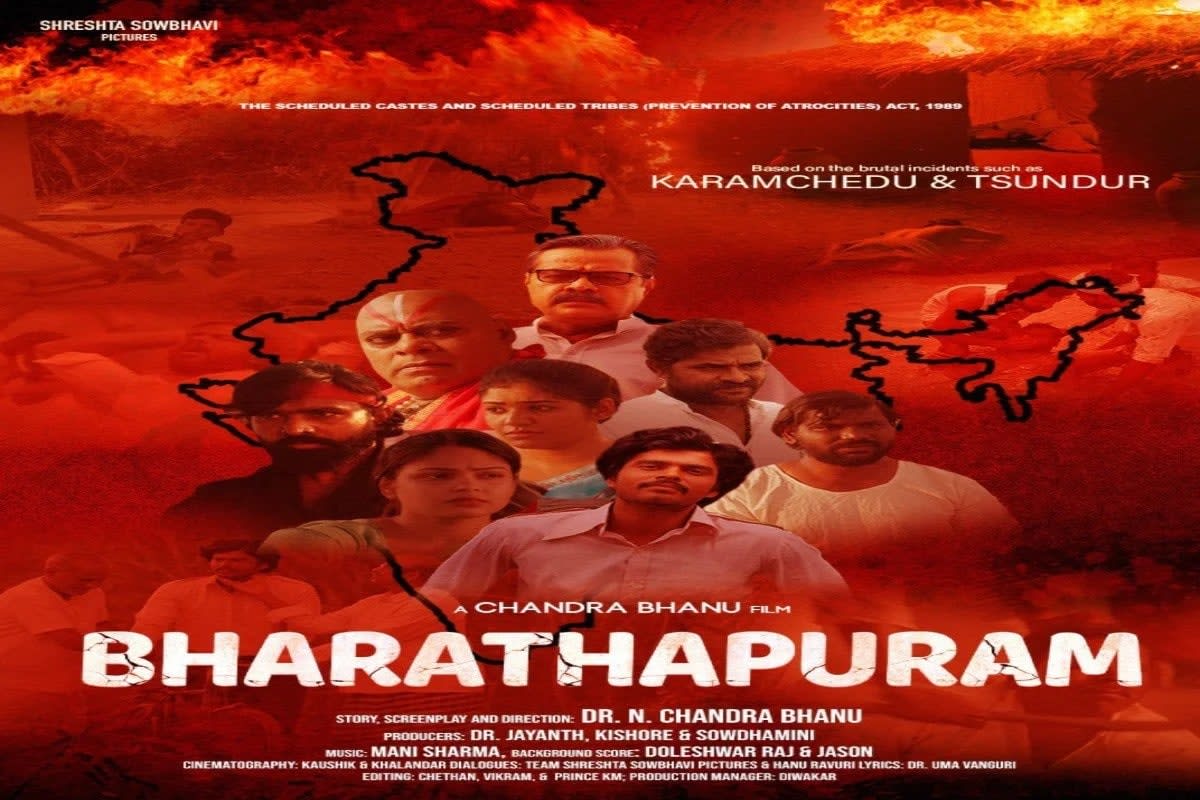
Are we going to see the story of the Karamchedu Massacre on the big screen in the form of the BHARATHAPURAM movie? A new movie BHARATHAPURAM is announced and explicitly declared that it is based on caste violence and the poster says it is “based on the brutal instances such as Karamchedu & Tsundur.” The director of the movie is Dr. N. Chandra Bhanu, and the cast includes newcomers Vardhan, Laavanya, and the established actors: Ajay Ghosh, Naagineedu, & Raghu Kunche. The director of the movie is an Assistant Professor at an university in New Delhi and researched on caste and the left politics for 15 years, based on which he is making the movie. Interestingly, the movie is produced by scholars and professors coming from various eminent institutions of this country.
A First-of-Its-Kind not only in Telugu but in Indian cinema?
In recent years, Tamil cinema has strongly engaged with caste politics and land struggles. Filmmakers like Pa. Ranjith and Vetrimaaran have consistently foregrounded themes of social justice, dignity, and resistance in rural and working-class settings. Their films didn’t merely depict violence—they contextualized it within structures of power and historical marginalization. In Telugu cinema, such attempts have been comparatively fewer. Only Palasa & Dandira are the notable efforts to explore caste and rural power hierarchies, but the space remains largely underrepresented in mainstream storytelling.
What makes Bharathapuram significant is that it appears to directly engage with the history of caste massacres in India. The makers have mentioned Kilvenmani, Karamchedu, & Tusndur massacres and many instances of violence on Dalits in the announcement video. They argued that land as a symbol of power and social control; Caste violence as organized dominance, not isolated anger; resistance as both dangerous and necessary. The tone is raw and serious. The violence shown—or implied—is not stylized for entertainment but rooted in structural injustice. While faction dramas and rural action films are common in Telugu and Indian cinema, a full-fledged narrative centered explicitly on caste massacres and land oppression as a feature of caste hierarchy is absent in Indian cinema. Therefore, if Bharathapuram sustains the vision and intensity promised in the announcement video, it could mark a defining moment not only for the Telugu cinema but also for the Indian filmmaking.
What are the KARAMCHEDU & Tsundure massacres?
On 17 July 1985, organized violence by members of the dominant Kamma caste against Dalits—primarily from the Madiga community—in Karamchedu village of Prakasam district resulted in six deaths, sexual assaults, widespread injury, and the displacement of Dalit families. The immediate reason for the violence was a Dalit youth objected to a Kamma man trying to clean a buffalo in a public drinking water tank used by Dalits. The objection was seen as a “challenge” to caste hierarchy, leading to organized retaliation by Kammas, the next day. The Tsundur massacre occurred on 6 August 1991 in Tsundur (Chundur) village, Guntur district, Andhra Pradesh. A mob of dominant-caste Reddys attacked and killed 10 Dalits (primarily from the Mala community). A minor altercation in a cinema hall between a Dalit youth and a dominant-caste youth reportedly triggered retaliatory planning. On 6 August, an organized mob chased Dalits into fields and killed them systematically. The disproportionate violence cannot be understood as spontaneous retaliation, according to Chandra Bhanu, and rather, it was a disciplinary assertion of caste hierarchy in a context of Dalit upward mobility (some of the Dalits attempted to become farmers, acquired education and small jobs) and tried to vote according to their preferences). We have to note that the kammas of Karamchedu, particularly, the Daggupati family were relatives of then Chief Minister N. T. Rama Rao. The son-in-law of N.T. Rama Rao, Daggupati Venkateswara Rao the then cabinet minister was from Karmchedu village.
Is it a Fiction or Depiction of True Events?
Bharathapuram is a politically sharp, and emotionally heavy, statement on history, land, and the unfinished struggle against caste violence. But at the same time, it is unlikely that we can see a biopic of the Karamchedu village as such a movie will invite legal and political challenges. However, it could be that the story of BHARATHAPURAM is largely similar/broadly inspired by the two infamous instances of Karamachedu and Tsundu as the makers declared in their poster.