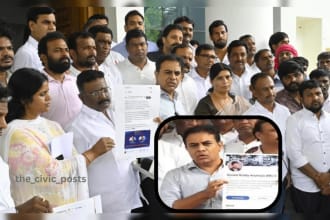
“Start Questioning Power” - KTR’s Strong Words Ignite Warangal Gathering
Alekhya Kota - MAY 6, 2026

A recent farmers’ meeting in Warangal turned into a strong political and social message-driven gathering, where K. T. Rama Rao addressed the farming community with a direct appeal to rethink how they respond to their challenges. His speech focused on encouraging farmers to move beyond silence and adopt a more assertive approach when dealing with issues related to agriculture and governance.
The central message of his address was clear: farmers should not limit themselves to repeatedly requesting solutions or waiting passively for government action. Instead, he urged them to question delays, demand accountability, and actively engage with the system to ensure that their concerns are properly addressed. This shift in approach, he suggested, could significantly strengthen their collective voice.
The gathering, held in Warangal, brought together a large number of farmers who are currently dealing with ongoing agricultural challenges. Issues such as procurement delays, inconsistent support systems, and uncertainty around welfare schemes formed the backdrop of the discussion. These concerns have been affecting the financial stability of many rural households, making the topic especially relevant.
KTR’s remarks highlighted the gap between policy announcements and ground-level implementation. While several schemes and promises are made for the agricultural sector, the actual delivery of benefits often faces delays or complications. According to the message conveyed during the meeting, this disconnect has created frustration among farmers who depend heavily on timely support for their livelihoods.
He emphasized that agriculture remains a crucial part of the state’s economy and that farmers form the backbone of rural development. Because of this, their issues cannot be treated lightly or delayed indefinitely. He argued that stronger participation from the farming community in questioning and monitoring systems could help improve efficiency and reduce administrative gaps.
Another key aspect of the speech was empowerment. Rather than portraying farmers as passive recipients of assistance, the message encouraged them to see themselves as active participants in the decision-making process. By questioning policies and raising collective concerns, farmers can push for more responsive governance and better implementation of welfare measures.
The discussion also touched upon the importance of unity among farmers. A coordinated and collective voice, it was suggested, carries more weight than individual complaints. When farmers come together to highlight issues, it becomes harder for their concerns to be overlooked. This sense of unity was presented as a crucial factor in achieving meaningful change.
In addition, the address indirectly reflected broader political dynamics in the state. Agriculture is not just an economic issue but also a significant political subject in Telangana. Policies related to farming, procurement, and rural welfare often influence public opinion and shape political narratives. As a result, discussions like these carry both social and political importance.
The speech also drew attention to the emotional and financial pressures faced by farmers. Uncertainty in crop procurement, fluctuations in support prices, and delays in financial assistance can have a direct impact on their livelihoods. These challenges often lead to stress and instability in rural communities, making timely intervention essential.
By urging farmers to question instead of plead, the message aimed to shift the mindset from dependency to assertiveness. This approach suggests that meaningful change is more likely when affected communities actively engage with the system rather than waiting for solutions to arrive on their own.
The gathering in Warangal also served as a reminder of the continuing importance of agriculture in regional development. Despite urban growth and industrial expansion, a large portion of the population still depends on farming for their income. This 1makes agricultural policy and its execution a critical area of focus for both governance and political leadership.
As the meeting concluded, the emphasis remained on awareness, participation, and collective strength. Farmers were encouraged to stay informed about their rights and to actively question any gaps in implementation. The underlying message was that stronger engagement can lead to better outcomes and improved accountability.
In conclusion, the Warangal meeting highlighted a shift in tone from passive acceptance to active questioning within the farming community. The address by K. T. Rama Rao focused on empowerment, urging farmers to assert their concerns more firmly and demand effective action. At its core, the message was about strengthening the voice of those who form the foundation of the rural economy and ensuring that their issues receive timely and meaningful attention.