Exit Polls: Democratic Forecasts or Media-Driven Gambling Spectacles?
Kranthi Vegesna - MAY 8, 2026

There was a time when exit polls generated immense excitement in Indian democracy. They were seen as an early indicator of public mood, a reflection of voter sentiment, and a scientific basis for political analysis. People would sit glued to television screens waiting to know: Who will secure the majority? Who will form the government? Political analysts, journalists, and ordinary citizens treated exit polls as a serious and credible exercise.
But times have changed.
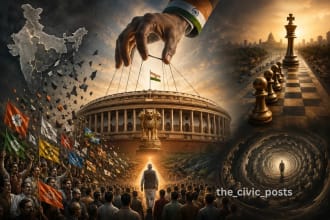
Today, public trust in exit polls has noticeably declined. What once appeared to be a democratic tool for understanding voter behavior is increasingly being criticized as a “media event,” a “political propaganda instrument,” and even fuel for betting markets.
Instead of strengthening democratic discussion, exit polls now seem, in many cases, to serve the race for television ratings more than the pursuit of political understanding.
What Are Exit Polls?
Exit polls are surveys conducted immediately after voters cast their ballots. Voters are asked whom they voted for, and based on this sample data, pollsters attempt to predict the final election outcome.
In theory, it is a scientific process. If done with proper sampling, regional balance, caste and class analysis, and urban-rural representation, exit polls can produce reasonably accurate estimates.
However, in a country as socially and politically diverse as India, the process is far more complicated than it appears.
The Journey of Exit Polls in India
Exit polls became popular in India during the 1990s alongside the rapid expansion of television media.
At first, they were viewed as a fascinating innovation. In several elections, poll predictions came close to the actual results, increasing their credibility. Political parties took them seriously, and even stock markets reacted to them.
But over time, major problems began to emerge:
Ten different channels predicting ten different outcomes for the same election
One channel projecting a landslide victory while another predicted defeat for the same party
Massive failures in predictions
Questions over the credibility of survey agencies after actual results were declared
Gradually, skepticism replaced trust.
Has “Drama” Replaced “Data”?
One thing is increasingly clear about modern exit polls: sensationalism often overshadows information.
Television studios are filled with giant graphics, dramatic music, flashing “breaking news” banners, emotional commentary from anchors, and constantly shifting seat projections. At times, the presentation resembles an entertainment spectacle more than a serious political analysis.
Every channel presents its prediction as the ultimate truth.
Words like:
“Tsunami”
“Wave”
“Shock”
“History”
“Clean Sweep”
are repeatedly used to create excitement.
While this may increase viewer engagement, an important question remains: Does it actually deepen public understanding of politics?
Exit Polls and Political Bias
One of the strongest criticisms today is the perception of political bias.
Many citizens and analysts believe that some exit polls are driven less by data and more by political alignment.
There are allegations that:
Certain media channels favor specific political parties
Some survey agencies are closely linked to political interests
Exit polls are used to create a “winner narrative” before official results are announced
According to critics, shaping public perception before the final count has become part of political strategy itself.
This raises an important democratic question: Is such influence healthy for electoral politics?
Fuel for Betting Markets
Perhaps the most alarming development is the growing connection between exit polls and betting culture.
As soon as voting concludes, large-scale betting reportedly begins in several regions:
Which party will win?
How many seats will it secure?
Who will become Chief Minister?
What will the majority margin be?
Exit polls often become the primary trigger for these betting markets.
The moment a major channel releases its predictions, betting rates fluctuate dramatically. Social media amplifies these numbers instantly.
Critics warn that elections risk being transformed from a democratic process into a gambling spectacle.
The Role of Social Media
Earlier, exit polls were largely confined to television debates. Today, social media spreads them at unprecedented speed.
YouTube channels, Twitter posts, WhatsApp forwards, fake graphics, and fabricated survey reports flood public discourse during elections.
Many unauthorized “exit polls” circulate without Election Commission approval, making it increasingly difficult for people to distinguish between genuine analysis and political propaganda.
Impact on Voter Psychology
Although official exit polls are released after voting concludes, leaks and unofficial surveys often emerge while voting is still ongoing in some phases.
Critics argue that this can influence remaining voters.
If voters begin to feel that “the winner has already been decided,” democratic enthusiasm may decline.
Exit polls can also affect party workers psychologically:
Overconfidence among those projected to win
Demoralization among those projected to lose
Both can shape the broader political atmosphere.
Where Is Media Responsibility?
The media plays a crucial role in democracy. Its responsibility is to inform, analyze, and create awareness among citizens.
However, in the case of exit polls, many media organizations appear more focused on the competition for ratings than on responsible journalism.
Election analysis is a serious democratic exercise. Yet some television channels present it like a reality show.
Hours of public attention are consumed by studio debates, while real issues such as:
Unemployment
Agrarian distress
Education
Healthcare
Rising prices
receive far less attention.
Why Do Exit Polls Fail?
There are several reasons why exit polls frequently fail in India:
1. Complex Social Diversity
India’s caste, religious, linguistic, and regional divisions make voter behavior extremely difficult to predict accurately.
2. The “Silent Voter”
Many voters simply do not reveal whom they actually voted for.
3. Women Voters
In several elections, women vote differently from their families, something surveys often fail to capture.
4. Sampling Errors
Small or poorly designed samples can lead to massive inaccuracies.
5. Political Pressure
There are also allegations that some projections are intentionally manipulated.
Are Exit Polls Necessary for Democracy?
This question is now being debated intensely.
Should exit polls be completely banned, or simply regulated more strictly?
Supporters argue that:
They increase public engagement
They help study political trends
They provide insights into voter behavior
Critics argue that:
They turn democracy into entertainment
They become tools of political propaganda
They encourage betting culture
What Is the Solution?
1. Stronger Regulation
Survey agencies conducting exit polls should follow strict professional standards.
2. Complete Transparency
Pollsters should disclose:
Sample size
Survey locations
Demographic breakdowns
Methodology used
3. Media Ethics
Exaggeration for ratings should be reduced.
4. Action Against Fake Surveys
Stronger measures are needed against fabricated polls circulating on social media.
5. Public Media Literacy
Citizens should understand that exit polls are only predictions-not final election results.
Exit polls should function as a democratic analytical tool. But when they become instruments of political propaganda, media sensationalism, and betting culture, the health of democracy suffers.
Democracy does not end on polling day. The discussions surrounding elections must also remain responsible and ethical.
Information should empower citizens-not turn them into consumers of manufactured suspense.
Exit polls were once symbols of credibility and political insight. If they are to regain public trust, they must return to the core principles of scientific rigor, transparency, and ethical responsibility.