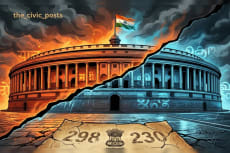
The Fall of Mamata Banerjee in West Bengal: Causes, Consequences, and Future Political Equations
Kranthi Vegesna - MAY 6, 2026

West Bengal politics have always been a theater of high drama. However, the recent defeat of the Mamata Banerjee-led All India Trinamool Congress (AITC) after nearly fifteen years of governance marks a seismic shift in Indian politics. This outcome is not merely the defeat of a party; it is a complex intersection of public sentiment, electoral strategy, and the critical role of opposition unity.
Anti-Incumbency After Long-Term Governance
Natural fatigue often sets in when a single government holds power for over a decade. Mamata Banerjee, who took the reins in 2011, had consolidated her position through successive victories. Yet, two factors proved decisive this time:
* The 15-Year Itch: Despite visible development, a segment of the populace harbored a deep-seated desire for change.
* The Quest for a New Alternative: Youth and urban voters shifted their gaze toward a "fresh alternative," providing the Bharatiya Janata Party (BJP) with a golden opportunity to fill the vacuum.
The Debate Over a "Level Playing Field"
The 2026 elections sparked intense debate regarding the fairness of the electoral arena. Critics pointed toward:
* Significant revisions in voter lists.
* The proactive role of central investigative agencies.
* Disparity in campaign resources.
While election bodies maintain these were standard administrative and legal procedures, a narrative emerged suggesting that the "playing field" was tilted, influencing the final outcome.
Leadership: The Age and Image Factor
At over 70 years old, Mamata Banerjee’s experience remains a formidable asset. However, opponents successfully turned her age into a talking point by:
* Highlighting the appeal of younger leadership among the Gen-Z and millennial demographic.
* Questioning the physical endurance and traditional campaign style required for a modern, high-octane election.
The BJP’s Aggressive Narrative
The BJP treated this election as a prestigious national battle. The top brass of the party descended upon Bengal, crafting a powerful narrative that:
* Combined local grievances with nationalistic themes.
* Organized massive rallies that demonstrated organizational might.
* Focused on a "Double Engine" growth model, which successfully boosted their vote share.
The Institutional Pivot and Security
The role of various institutions became a flashpoint during the polls. The actions of central agencies, the decisions of the Election Commission of India, and various court rulings were viewed through a partisan lens by the opposition.
Furthermore, the heavy deployment of Central Forces at polling stations was a double-edged sword. While it effectively curtailed the state's history of poll violence, it also became a point of political contention regarding state autonomy.
The Achilles' Heel: Lack of Opposition Unity
The most critical factor in Mamata’s defeat was the fragmentation of the opposition.
* Failed Alliances: The Trinamool Congress did not forge a pact with the Congress.
* Divided Vote Bank: Disagreements over seat-sharing led to a split in the anti-BJP vote.
Analysts suggest that had there been a unified front with the Rahul Gandhi-led Congress, the results might have been vastly different. This mirrors the challenges faced by Arvind Kejriwal in Delhi, where a divided opposition often benefits the primary challenger.
International Parallel: The Hungary Example
Political scientists often cite the Hungarian model, where a diverse range of opposition parties united under a common minimum program to challenge a dominant incumbent. The Bengal results suggest that in the Indian context:
1. Regional party unity is essential.
2. A shared agenda is more effective than individual charisma.
3. Strategic seat-sharing is the only way to counter a disciplined electoral machine.
Impact and the Road Ahead
The fall of the "Bengal Fortress" has implications that reach far beyond Kolkata:
* National Momentum: The BJP’s influence in national politics receives a significant boost.
* Strategic Reset: Regional parties must now rethink their survival strategies.
* Unity as Necessity: The need for a cohesive "National Front" has become a matter of political survival rather than a choice.
Conclusion
The West Bengal elections serve as a masterclass in modern Indian democracy. The defeat of a leader as resilient as Mamata Banerjee proves that the desire for change is an inherent democratic force. Simultaneously, it showcases the BJP's strategic expansionism.
The message for the future is clear: without unity and a cohesive strategy, the opposition will find it increasingly difficult to stall the BJP’s momentum. As the saying goes, "A good lesson should be learned from anywhere"-and this election has provided plenty.