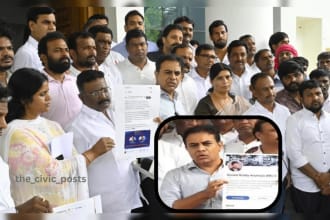
Long-Pending Demand: Dalit Christians SC Status Issue Returns to Spotlight
Telangana Leaders Raise Concerns Over Constitutional Rights and Social Justice
Kranthi Shekar - APR 10, 2026

A fresh political debate has emerged in Telangana after leaders alleged that the Central government is attempting to prevent Scheduled Caste (SC) status from being extended to Dalit Christians. The issue has sparked discussion on social justice, constitutional provisions, and the rights of marginalized communities.
Leaders Voice Concern Over Denial of Benefits
Several political and community leaders expressed concern that Dalit Christians continue to face social discrimination despite religious conversion, yet they remain excluded from Scheduled Caste benefits. They argued that caste-based discrimination does not disappear after conversion and therefore denying SC status creates inequality.
Leaders claimed that extending SC status would help improve access to education, employment, and welfare schemes. They emphasized that the demand has existed for decades, but no concrete decision has been taken at the national level.
The controversy gained momentum following recent legal and political developments regarding caste status after religious conversion. These developments have once again brought attention to the long-standing demand of Dalit Christian groups.
Constitutional Debate Over SC Status
Currently, Scheduled Caste status is governed by constitutional provisions that historically limited benefits to certain religious communities. Over time, the eligibility was expanded to include additional groups, but Dalit Christians and Dalit Muslims continue to remain outside the SC category.
Supporters of extending SC status argue that caste discrimination is social in nature and continues even after conversion. Therefore, they believe that reservations and protections should be based on social realities rather than religion.
On the other hand, those opposing the demand argue that the reservation system was originally designed to address caste-based discrimination within specific religious frameworks. They contend that extending benefits beyond those categories may require constitutional amendments and broader policy decisions.
Growing Demands From Community Groups
Dalit Christian organizations have repeatedly called for inclusion in the Scheduled Caste list. Community representatives stated that many families continue to face economic hardships and social exclusion even after adopting a different religion.
They also pointed out that access to reservation benefits in education and government employment remains limited, which affects opportunities for social mobility. Activists argued that granting SC status would help address long-standing inequalities.
Several groups have urged both the state and central governments to take a clear stand on the issue. They also demanded that the matter be examined through consultations and policy discussions.
Political Reactions Intensify
The issue has also taken a political turn, with leaders criticizing the Centre for delaying decisions. Some leaders claimed that denying SC status to Dalit Christians goes against the principles of equality and social justice.
Meanwhile, other political voices supported maintaining the existing framework, stating that any changes should be carefully studied. They stressed that the matter involves legal, constitutional, and social considerations.
The debate has highlighted differences in opinion among political parties, with each side presenting its own arguments regarding the future of reservation policies.
Impact on Social Justice Policies
Experts believe that the issue could have far-reaching implications for reservation policies in India. Extending SC status to Dalit Christians could influence similar demands from other communities.
The debate also raises questions about how caste identity and religion intersect in modern society. Policymakers may need to consider historical discrimination, present-day realities, and constitutional provisions while addressing the issue.
Calls for Dialogue and Review
Community leaders and activists have called for meaningful dialogue between governments and stakeholders. They urged policymakers to examine reports, recommendations, and ground-level realities before taking a final decision.
Some leaders suggested forming committees or conducting studies to understand the socio-economic conditions of Dalit Christians. Such measures, they believe, could help in framing balanced policies.
Issue Continues to Gain Attention
The demand for SC status for Dalit Christians has resurfaced multiple times over the years. With fresh political reactions and renewed discussions, the issue is once again gaining national attention.
As debates continue, the decision on whether to extend SC status remains uncertain. However, the growing voices from Telangana indicate that the matter is likely to remain an important topic in political and social discussions in the coming months.
The outcome of this debate could play a significant role in shaping future reservation policies and the broader conversation on equality and social justice in India.