Editorial

Growing Resistance to Demolition Drives – A Serious Question on Democracy, Justice, and Equality

Kranthi Vegesna - FEB 16, 2026
Share:
Growing Resistance to Demolition Drives – A Serious Question on Democracy, Justice, and Equality

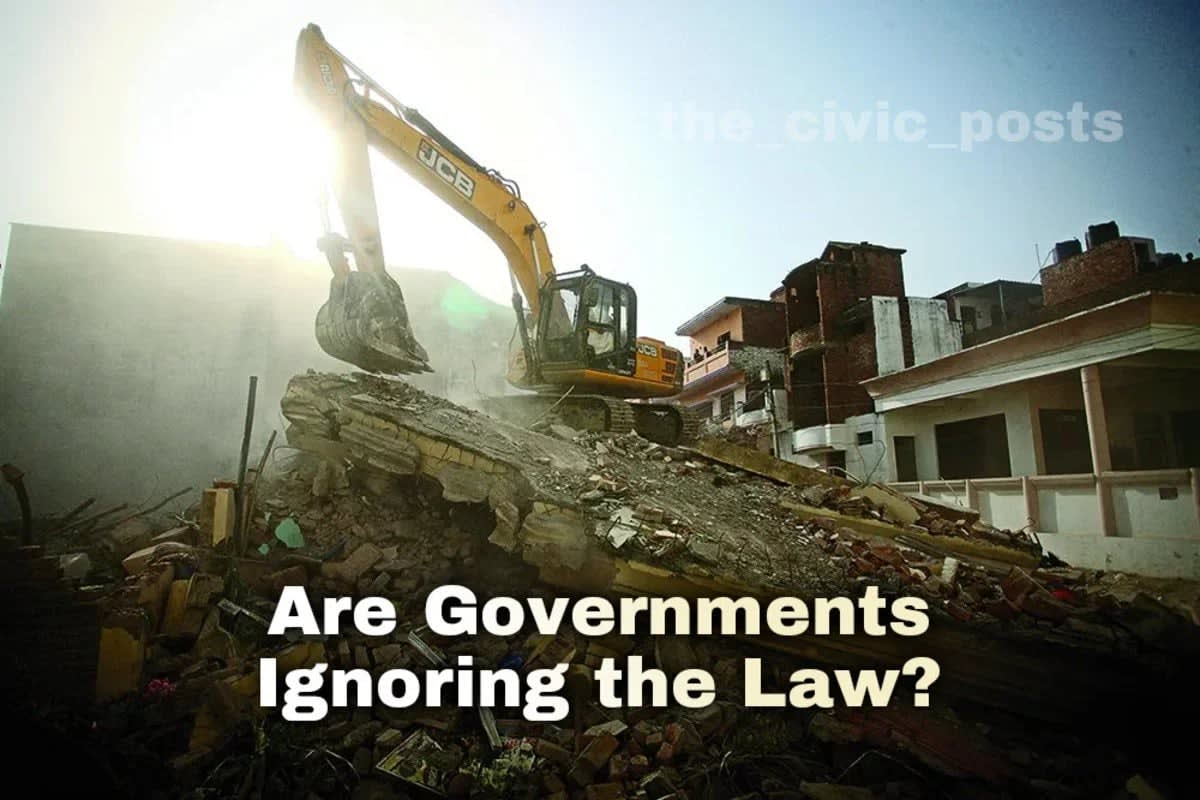
In recent years, one issue has become highly debated across India — the demolition of houses. While such actions existed in the past, today, with the expansion of social media, these incidents are coming out in the open and triggering nationwide discussions. The visuals of bulldozers crushing the homes of the poor, daily wage workers, small traders, and street vendors have shaken the conscience of the nation.

This issue raises many questions: Which law? For whom? When? How? Why?

This is not just a legal issue — it is a larger question about whether justice is truly being delivered to the poor and marginalized sections of society.

Why Are the Poor the Main Targets — and Why Are the Rich Exempt?

People have begun noticing one crucial fact: demolition drives mostly target the poor.

But in the same areas, if illegal constructions belong to wealthy individuals, political leaders, or influential people, the government rarely touches them.

For example:

A poor person’s hut, tin shed, or small house gets demolished overnight calling it “illegal construction.”

Meanwhile, expensive multi-crore buildings in the same locality may also be illegal — yet they continue to remain untouched.

This raises fundamental doubts: Is everyone equal before the law?

Or is the poor man always the weakest before the law?

Are These Actions Truly Legal — or Are They Political Retaliation?

Observing different incidents across states, one can sense multiple intentions behind such demolition drives:

Retaliatory action against individuals accused of crimes

Pressure tactics on supporters of political opponents

Clearing poor settlements in the name of development projects

According to the law, if a person commits a crime, only that person must be punished — not his wife, children, or elderly parents.

But demolitions punish the innocent family, not the accused individual. This is something no court of law approves.

Even After Supreme Court Warnings, No One Seems to Care

The Supreme Court has repeatedly stated:

Demolishing the homes of people accused of crimes is illegal

For any illegal construction, authorities must issue notice, conduct hearings, and provide alternative options

Demolition cannot be used as retaliation

But in several states, these rules are ignored.

Sometimes notices are issued just hours before demolition.

Sometimes no notice is given at all.

This leads people to ask: “If states don’t follow the Supreme Court, will they ever listen to the people?”

Destruction of the Poor’s Property — But Who Sees Their Pain?

For the poor, their only assets are:

A small hut

A single-room house

A tiny shop

A pushcart or handcart

These may not be worth lakhs or crores — but for them, these assets are priceless, because their survival depends on them.

Videos of bulldozers crushing carts, shops, and shelters evoke deep anger and helplessness.

A scene from one location, where the carts of small vendors were lined up and smashed one by one, left many hearts shaken.

How will they earn again?

What will their families eat?

What about their children’s education?

This is not just property loss — it is the destruction of their entire future.

Why Are the Poor Always the Easy Victims?

Sociologists point to an important reality — the poor do not break the law intentionally; it is the failure of the system to reach them.

Urban slums emerge due to:

Low income

No affordable housing

Negligence from authorities

For the sake of their children, they build a small shelter.

But during development projects, theirs are the first homes to be destroyed.

Whenever asked, the government has no answer to their question:

“Where should we go?”

If Demolition Is Necessary, Why Not Provide Alternatives First?

Governments have the authority to enforce the law.

If illegal structures exist, they can take action.

But the question is:

Is it fair to throw poor families onto the streets without offering alternatives?

Before demolition, authorities must ensure:

Rehabilitation

Alternative housing

Temporary shelters

Compensation

Demolition shouldn’t be a show of power; it should be handled with responsibility and humanity.

UP’s ‘Bulldozer Politics’ — A Trend Spreading Across India?

In Uttar Pradesh, bulldozers were used against individuals accused of crimes, portraying it as “tough action.”

But many legal experts criticized this approach:

No law in the world allows punishment of an entire family

Illegal constructions cannot exist without the involvement of officials

Even if the individual is jailed, how does demolishing the house become justified?

This model has slowly begun spreading to other states, raising fears:

“Is India adopting a culture of punishment before legal trial?”

In a Democracy, the Strength of the State Should Be Law — Not Bulldozers

Democracy is built on:

Equality before law

Fair justice

Notices

The right to be heard

The right to rehabilitation

If these are ignored and bulldozers are brought forward, democracy doesn’t become stronger — it becomes weaker.

A government’s strength must lie in protection, not destruction.

Role of Media, NGOs, and Courts

To address this issue collectively:

Media must report unbiasedly

NGOs must educate people about their rights and rehabilitation

Courts must monitor strictly

Governments must apply laws equally

Public representatives must speak for the poor

Conclusion — Building Takes Years, Destroying Takes Minutes

Every small house, shop, and cart represents years of hard work for a poor family.

Governments acting against illegal constructions is welcome —

but targeting only the poor is unjust.

Before demolishing buildings, governments must ensure that lives are not demolished.

Law is not meant to protect the powerful —

Law is meant to protect the powerless.

Democracy thrives not in the roar of bulldozers —

but in the voice of justice.

More Articles

Recent Articles

Shift to PNG Gains Momentum: LPG Supply May Stop Where Pipeline Gas Exists

Shift to PNG Gains Momentum: LPG Supply May Stop Where Pipeline Gas Exists

Kranthi Shekar - MAR 26, 2026

From Sacrifice to Inspiration: Narayana Speaks on Potti Sriramulu’s Legacy

From Sacrifice to Inspiration: Narayana Speaks on Potti Sriramulu’s Legacy

Kranthi Shekar - MAR 26, 2026

Hyderabad Traffic Diversions Announced for Sri Rama Navami Procession

Hyderabad Traffic Diversions Announced for Sri Rama Navami Procession

Kranthi Shekar - MAR 26, 2026

₹1000 Crore Rampage: Dhurandhar 2 Targets Pushpa 2: The Rule After Historic First Week

₹1000 Crore Rampage: Dhurandhar 2 Targets Pushpa 2: The Rule After Historic First Week

Kranthi Shekar - MAR 26, 2026

Can Ustaad Bhagat Singh Cross ₹100 Crore This Weekend? Box Office Race Gets Intense

Can Ustaad Bhagat Singh Cross ₹100 Crore This Weekend? Box Office Race Gets Intense

Kranthi Shekar - MAR 26, 2026

Fuel Scare in Hyderabad: Panic Buying Leaves Several Petrol Pumps Running Low

Fuel Scare in Hyderabad: Panic Buying Leaves Several Petrol Pumps Running Low

Kranthi Shekar - MAR 26, 2026

A Bitter Victory—South Africa Claims the Decider in a Series Defined by Scheduling Chaos

A Bitter Victory—South Africa Claims the Decider in a Series Defined by Scheduling Chaos

Kranthi Vegesna - MAR 26, 2026

The Multi-Billion Dollar Changing of the Guard: IPL’s New Ownership Era

The Multi-Billion Dollar Changing of the Guard: IPL’s New Ownership Era

Kranthi Vegesna - MAR 26, 2026

Miami Open 2026: Sinner Rewrites the Record Books as the Draw Opens Wide

Miami Open 2026: Sinner Rewrites the Record Books as the Draw Opens Wide

Kranthi Vegesna - MAR 26, 2026

The Fracturing of Peace-The Alarming Normalization of Hate Speech in India

The Fracturing of Peace-The Alarming Normalization of Hate Speech in India

Kranthi Vegesna - MAR 26, 2026

Self-Governance for Dalit Colonies and Lambada Tandas: Decentralization is the Sustainable Solution

Self-Governance for Dalit Colonies and Lambada Tandas: Decentralization is the Sustainable Solution

Kranthi Vegesna - MAR 26, 2026

“India Lockdown Again?” Viral Rumours Spark Panic After PM Modi Speech - Here’s What’s Really Happening

“India Lockdown Again?” Viral Rumours Spark Panic After PM Modi Speech - Here’s What’s Really Happening

Kranthi Shekar - MAR 25, 2026

$350M Crude Deal: Reliance Capitalizes on Temporary US Sanctions Waiver

$350M Crude Deal: Reliance Capitalizes on Temporary US Sanctions Waiver

Kranthi Shekar - MAR 25, 2026

Strength Training: Why India Needs to Re-think Fitness

Strength Training: Why India Needs to Re-think Fitness

Jennifer - MAR 25, 2026

In India, mango isn’t just a fruit-it’s the king of fruits.

In India, mango isn’t just a fruit-it’s the king of fruits.

Prakash Ranganathan - MAR 24, 2026

India Rising Fast, But Global Competition Intensifies: Key Takeaway from Bihar Sports Conclave

India Rising Fast, But Global Competition Intensifies: Key Takeaway from Bihar Sports Conclave

Kranthi Shekar - MAR 24, 2026

Telangana Cabinet Clears Key Bills to Tackle Hate Speech and Strengthen Family Responsibility

Telangana Cabinet Clears Key Bills to Tackle Hate Speech and Strengthen Family Responsibility

Kranthi Shekar - MAR 24, 2026

Iran Launches Missile Strikes on Israel, Rejects Trump’s Negotiation Claims

Iran Launches Missile Strikes on Israel, Rejects Trump’s Negotiation Claims

Kranthi Shekar - MAR 24, 2026

Andhra Pradesh Sets Stage for Industrial Boom with ₹1.36 Lakh Crore Steel Giant

Andhra Pradesh Sets Stage for Industrial Boom with ₹1.36 Lakh Crore Steel Giant

Kranthi Shekar - MAR 24, 2026

The Silent Chimes of the Nandi-Is the Golden Era of Telugu Cinema Awards Fading?

The Silent Chimes of the Nandi-Is the Golden Era of Telugu Cinema Awards Fading?

Kranthi Shekar - MAR 24, 2026

Editorial

Growing Resistance to Demolition Drives – A Serious Question on Democracy, Justice, and Equality

Kranthi Vegesna - FEB 16, 2026

Share:
Growing Resistance to Demolition Drives – A Serious Question on Democracy, Justice, and Equality

In recent years, one issue has become highly debated across India — the demolition of houses. While such actions existed in the past, today, with the expansion of social media, these incidents are coming out in the open and triggering nationwide discussions. The visuals of bulldozers crushing the homes of the poor, daily wage workers, small traders, and street vendors have shaken the conscience of the nation.

This issue raises many questions: Which law? For whom? When? How? Why?

This is not just a legal issue — it is a larger question about whether justice is truly being delivered to the poor and marginalized sections of society.

Why Are the Poor the Main Targets — and Why Are the Rich Exempt?

People have begun noticing one crucial fact: demolition drives mostly target the poor.

But in the same areas, if illegal constructions belong to wealthy individuals, political leaders, or influential people, the government rarely touches them.

For example:

A poor person’s hut, tin shed, or small house gets demolished overnight calling it “illegal construction.”

Meanwhile, expensive multi-crore buildings in the same locality may also be illegal — yet they continue to remain untouched.

This raises fundamental doubts: Is everyone equal before the law?

Or is the poor man always the weakest before the law?

Are These Actions Truly Legal — or Are They Political Retaliation?

Observing different incidents across states, one can sense multiple intentions behind such demolition drives:

Retaliatory action against individuals accused of crimes

Pressure tactics on supporters of political opponents

Clearing poor settlements in the name of development projects

According to the law, if a person commits a crime, only that person must be punished — not his wife, children, or elderly parents.

But demolitions punish the innocent family, not the accused individual. This is something no court of law approves.

Even After Supreme Court Warnings, No One Seems to Care

The Supreme Court has repeatedly stated:

Demolishing the homes of people accused of crimes is illegal

For any illegal construction, authorities must issue notice, conduct hearings, and provide alternative options

Demolition cannot be used as retaliation

But in several states, these rules are ignored.

Sometimes notices are issued just hours before demolition.

Sometimes no notice is given at all.

This leads people to ask: “If states don’t follow the Supreme Court, will they ever listen to the people?”

Destruction of the Poor’s Property — But Who Sees Their Pain?

For the poor, their only assets are:

A small hut

A single-room house

A tiny shop

A pushcart or handcart

These may not be worth lakhs or crores — but for them, these assets are priceless, because their survival depends on them.

Videos of bulldozers crushing carts, shops, and shelters evoke deep anger and helplessness.

A scene from one location, where the carts of small vendors were lined up and smashed one by one, left many hearts shaken.

How will they earn again?

What will their families eat?

What about their children’s education?

This is not just property loss — it is the destruction of their entire future.

Why Are the Poor Always the Easy Victims?

Sociologists point to an important reality — the poor do not break the law intentionally; it is the failure of the system to reach them.

Urban slums emerge due to:

Low income

No affordable housing

Negligence from authorities

For the sake of their children, they build a small shelter.

But during development projects, theirs are the first homes to be destroyed.

Whenever asked, the government has no answer to their question:

“Where should we go?”

If Demolition Is Necessary, Why Not Provide Alternatives First?

Governments have the authority to enforce the law.

If illegal structures exist, they can take action.

But the question is:

Is it fair to throw poor families onto the streets without offering alternatives?

Before demolition, authorities must ensure:

Rehabilitation

Alternative housing

Temporary shelters

Compensation

Demolition shouldn’t be a show of power; it should be handled with responsibility and humanity.

UP’s ‘Bulldozer Politics’ — A Trend Spreading Across India?

In Uttar Pradesh, bulldozers were used against individuals accused of crimes, portraying it as “tough action.”

But many legal experts criticized this approach:

No law in the world allows punishment of an entire family

Illegal constructions cannot exist without the involvement of officials

Even if the individual is jailed, how does demolishing the house become justified?

This model has slowly begun spreading to other states, raising fears:

“Is India adopting a culture of punishment before legal trial?”

In a Democracy, the Strength of the State Should Be Law — Not Bulldozers

Democracy is built on:

Equality before law

Fair justice

Notices

The right to be heard

The right to rehabilitation

If these are ignored and bulldozers are brought forward, democracy doesn’t become stronger — it becomes weaker.

A government’s strength must lie in protection, not destruction.

Role of Media, NGOs, and Courts

To address this issue collectively:

Media must report unbiasedly

NGOs must educate people about their rights and rehabilitation

Courts must monitor strictly

Governments must apply laws equally

Public representatives must speak for the poor

Conclusion — Building Takes Years, Destroying Takes Minutes

Every small house, shop, and cart represents years of hard work for a poor family.

Governments acting against illegal constructions is welcome —

but targeting only the poor is unjust.

Before demolishing buildings, governments must ensure that lives are not demolished.

Law is not meant to protect the powerful —

Law is meant to protect the powerless.

Democracy thrives not in the roar of bulldozers —

but in the voice of justice.

More Articles

Recent Articles

Shift to PNG Gains Momentum: LPG Supply May Stop Where Pipeline Gas Exists

Shift to PNG Gains Momentum: LPG Supply May Stop Where Pipeline Gas Exists

Kranthi Shekar - MAR 26, 2026

From Sacrifice to Inspiration: Narayana Speaks on Potti Sriramulu’s Legacy

From Sacrifice to Inspiration: Narayana Speaks on Potti Sriramulu’s Legacy

Kranthi Shekar - MAR 26, 2026

Hyderabad Traffic Diversions Announced for Sri Rama Navami Procession

Hyderabad Traffic Diversions Announced for Sri Rama Navami Procession

Kranthi Shekar - MAR 26, 2026

₹1000 Crore Rampage: Dhurandhar 2 Targets Pushpa 2: The Rule After Historic First Week

₹1000 Crore Rampage: Dhurandhar 2 Targets Pushpa 2: The Rule After Historic First Week

Kranthi Shekar - MAR 26, 2026

Can Ustaad Bhagat Singh Cross ₹100 Crore This Weekend? Box Office Race Gets Intense

Can Ustaad Bhagat Singh Cross ₹100 Crore This Weekend? Box Office Race Gets Intense

Kranthi Shekar - MAR 26, 2026

Fuel Scare in Hyderabad: Panic Buying Leaves Several Petrol Pumps Running Low

Fuel Scare in Hyderabad: Panic Buying Leaves Several Petrol Pumps Running Low

Kranthi Shekar - MAR 26, 2026

A Bitter Victory—South Africa Claims the Decider in a Series Defined by Scheduling Chaos

A Bitter Victory—South Africa Claims the Decider in a Series Defined by Scheduling Chaos

Kranthi Vegesna - MAR 26, 2026

The Multi-Billion Dollar Changing of the Guard: IPL’s New Ownership Era

The Multi-Billion Dollar Changing of the Guard: IPL’s New Ownership Era

Kranthi Vegesna - MAR 26, 2026

Miami Open 2026: Sinner Rewrites the Record Books as the Draw Opens Wide

Miami Open 2026: Sinner Rewrites the Record Books as the Draw Opens Wide

Kranthi Vegesna - MAR 26, 2026

The Fracturing of Peace-The Alarming Normalization of Hate Speech in India

The Fracturing of Peace-The Alarming Normalization of Hate Speech in India

Kranthi Vegesna - MAR 26, 2026

Self-Governance for Dalit Colonies and Lambada Tandas: Decentralization is the Sustainable Solution

Self-Governance for Dalit Colonies and Lambada Tandas: Decentralization is the Sustainable Solution

Kranthi Vegesna - MAR 26, 2026

“India Lockdown Again?” Viral Rumours Spark Panic After PM Modi Speech - Here’s What’s Really Happening

“India Lockdown Again?” Viral Rumours Spark Panic After PM Modi Speech - Here’s What’s Really Happening

Kranthi Shekar - MAR 25, 2026

$350M Crude Deal: Reliance Capitalizes on Temporary US Sanctions Waiver

$350M Crude Deal: Reliance Capitalizes on Temporary US Sanctions Waiver

Kranthi Shekar - MAR 25, 2026

Strength Training: Why India Needs to Re-think Fitness

Strength Training: Why India Needs to Re-think Fitness

Jennifer - MAR 25, 2026

In India, mango isn’t just a fruit-it’s the king of fruits.

In India, mango isn’t just a fruit-it’s the king of fruits.

Prakash Ranganathan - MAR 24, 2026

India Rising Fast, But Global Competition Intensifies: Key Takeaway from Bihar Sports Conclave

India Rising Fast, But Global Competition Intensifies: Key Takeaway from Bihar Sports Conclave

Kranthi Shekar - MAR 24, 2026

Telangana Cabinet Clears Key Bills to Tackle Hate Speech and Strengthen Family Responsibility

Telangana Cabinet Clears Key Bills to Tackle Hate Speech and Strengthen Family Responsibility

Kranthi Shekar - MAR 24, 2026

Iran Launches Missile Strikes on Israel, Rejects Trump’s Negotiation Claims

Iran Launches Missile Strikes on Israel, Rejects Trump’s Negotiation Claims

Kranthi Shekar - MAR 24, 2026

Andhra Pradesh Sets Stage for Industrial Boom with ₹1.36 Lakh Crore Steel Giant

Andhra Pradesh Sets Stage for Industrial Boom with ₹1.36 Lakh Crore Steel Giant

Kranthi Shekar - MAR 24, 2026

The Silent Chimes of the Nandi-Is the Golden Era of Telugu Cinema Awards Fading?

The Silent Chimes of the Nandi-Is the Golden Era of Telugu Cinema Awards Fading?

Kranthi Shekar - MAR 24, 2026