Storm Over SIR in West Bengal: Cleansing the Voter List or a Mask for Electoral Politics?
Kranthi Vegesna - FEB 25, 2026
Politics in West Bengal has once again entered a phase of intense tension. This time, the controversy revolves around the Special Intensive Revision (SIR) undertaken by the Election Commission of India as part of the voter list revision process. Compared to the routine annual revision, this deeper exercise has sparked a major debate after allegations that it led to the deletion of a large number of voter names.
The issue gained national attention after Chief Minister Mamata Banerjee strongly opposed the process and approached the Supreme Court of India.
---
What is SIR? What is the Election Commission’s Objective?
According to the Election Commission, the Special Intensive Revision is not a routine update. It is a comprehensive exercise being carried out for the first time since 2002–04. Its key objectives include:
Cleaning the voter rolls: Correcting errors that have accumulated since 2002.
Removing duplicate entries: Identifying individuals registered in multiple locations.
Deleting ineligible names: Such as deceased voters or those who have migrated to other states.
Data standardization: Correcting inconsistencies in age, father’s name, address, and other details.
The Commission argues that without a transparent and accurate electoral roll, the democratic system weakens. Hence, Booth Level Officers (BLOs) have been directed to carry out door-to-door verification.
---
Why Has Controversy Erupted in Bengal?
During the implementation of SIR in West Bengal, the ruling party All India Trinamool Congress alleged that nearly 5.8 million voters had their names removed from the rolls. The state government has called this an unusually high number.
1. Legacy Data Issues
The Election Commission attempted to match the current voter list with the 2002 electoral database. Reports suggest around 3 million voters faced a “No Mapping” issue, meaning their records could not be linked with older data.
2. Language and Spelling Problems
Many Bengali names were translated into English with spelling variations. As a result, several genuine voters were reportedly flagged as “incorrect” entries and received notices.
3. Residence Verification Difficulties
The requirement to produce old documents to prove eligibility created challenges for poorer citizens and migrant workers. Anxiety has been particularly visible in border districts.
---
Mamata Banerjee’s Allegations: A Backdoor NRC?
Chief Minister Mamata Banerjee personally appearing before the Supreme Court underlines the seriousness of the dispute. Her major allegations include:
Backdoor NRC: She claims SIR is an indirect attempt to implement the National Register of Citizens.
Wrongful deletions: Names of living voters allegedly marked as deceased.
Unilateral approach: Appointment of micro-observers from outside the state instead of officials suggested by the state government.
---
Supreme Court’s Intervention: Attempt at Balance
On February 20, 2026, the Supreme Court issued important directions:
Judicial supervision: The process should continue under the supervision of judges from the Calcutta High Court.
Appointment of EROs: District-judge-level officers to serve as Electoral Registration Officers.
Extended deadline: The revision timeline extended by one week.
Transparency: A list of 12.5 million flagged names must be publicly displayed.
The court aims to maintain the independence of the Election Commission while protecting voters’ rights.
---
Normal Revision vs Special Intensive Revision
Summary Revision (Routine Process):
Conducted annually
Changes based mainly on applications
No large-scale door-to-door verification
Special Intensive Revision (SIR):
A massive review after nearly two decades
Door-to-door verification
Matching with legacy databases
Possibility of large-scale deletions
For this reason, the Election Commission insists that SIR is a system-wide audit, not a routine update.
---
Political Implications
With assembly elections expected later this year in West Bengal, the exercise has inevitably taken on a political color.
The ruling Trinamool Congress claims it targets specific voter groups, while parties aligned with the central government argue that it is necessary to ensure transparency and credibility in elections.
---
Situation in Other States
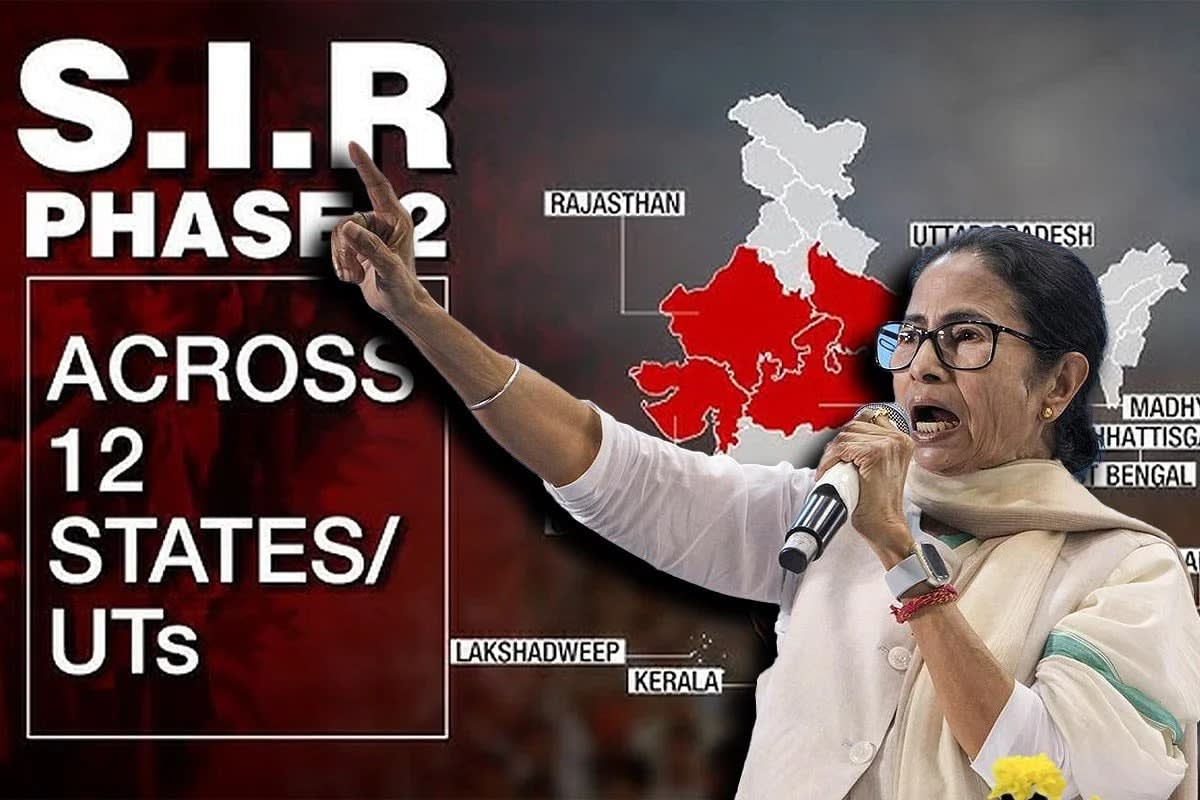
At present, SIR is underway in 12 states and union territories across India. In the next phase, states such as Andhra Pradesh, Telangana, and the Delhi are expected to see similar exercises. However, the sharpest political reaction has emerged from West Bengal.
-
Is This Truly a “Manipulative” Exercise?
The answer depends largely on political perspective.
Critics argue:
Large-scale deletions ahead of elections are suspicious.
Poor and migrant communities face hardships.
It could be linked to NRC-style verification.
Election Commission’s stance:
Removal of duplicate votes.
Deletion of names of deceased individuals.
Creation of a transparent and accurate voter list.
The truth may ultimately emerge under judicial scrutiny.
---
A Test for Democracy
The right to vote is one of the most fundamental pillars of India’s democracy. On one hand, an accurate voter list is essential. On the other, even a single eligible voter being wrongly excluded is unacceptable.
The SIR controversy in West Bengal has become a test of how these two principles can be balanced. The independence of the Election Commission, the rights of state governments, and the protection of voters—all converge in this issue.
---
Conclusion
Is the SIR process an effort to cleanse the electoral system, or a move timed for political advantage ahead of elections? The answer lies in transparent implementation and judicial oversight.
In a democracy, the sanctity of the vote must be protected. At the same time, the accuracy of voter rolls is equally crucial. Striking the right balance between these two remains the central challenge before the Election Commission, governments, and the judiciary.