Vijayasai Reddy Raises Tough Questions for Both Jagan and Chandrababu
Alekhya Kota - JUL 3, 2026
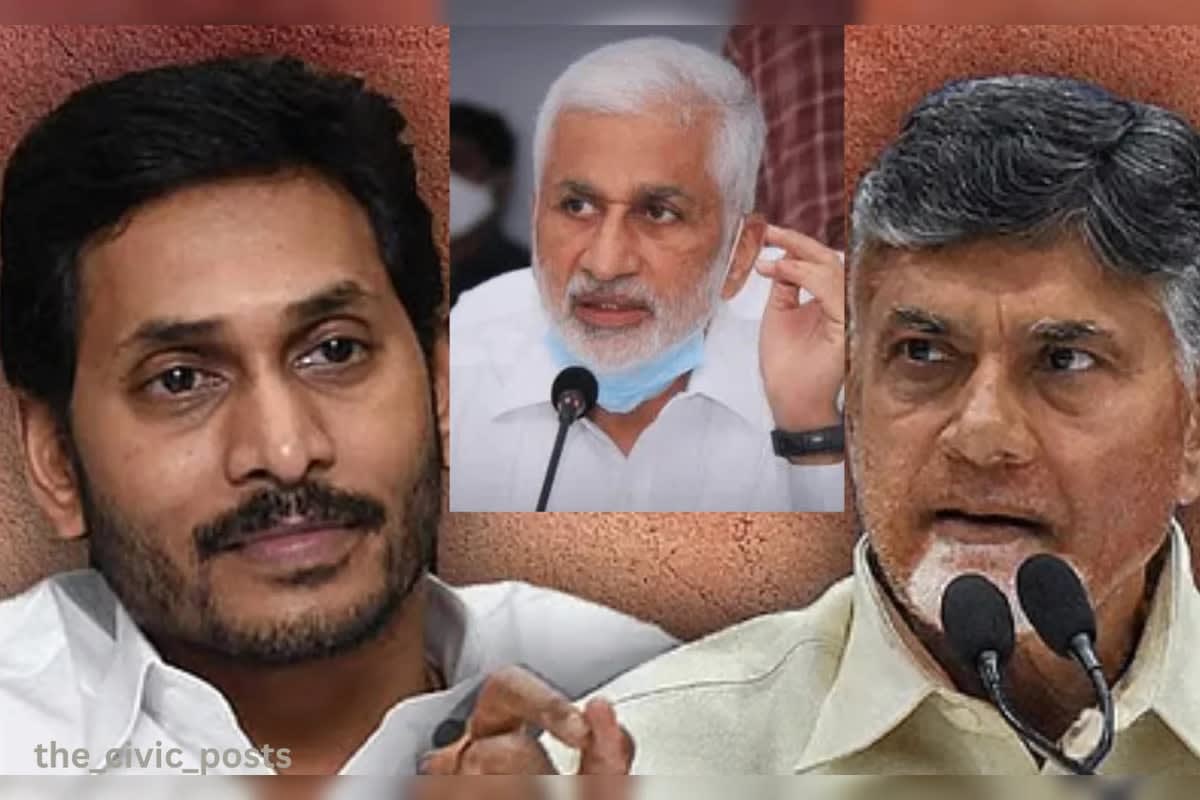
The long-running debate over Andhra Pradesh's capital has once again taken center stage after former Rajya Sabha member Vijayasai Reddy launched a sharp criticism of both Chief Minister N. Chandrababu Naidu and YSR Congress Party president Y.S. Jagan Mohan Reddy. At a time when political parties are once again making Amaravati a key issue, Vijayasai argued that the discussion has drifted away from the real concerns of the people and has instead become a recurring political weapon.
His remarks have added another dimension to the already heated political atmosphere in Andhra Pradesh, where the capital issue continues to influence governance, development, and electoral politics. By questioning leaders from both the ruling and opposition camps, Vijayasai has positioned himself as someone dissatisfied with the manner in which successive governments have handled one of the state's most significant policy decisions.
According to Vijayasai Reddy, Andhra Pradesh has spent more than a decade debating the location and future of its capital without reaching a lasting consensus. He questioned why political leaders have repeatedly ignored the recommendations made by the expert committee constituted after the state's bifurcation. In his view, the capital issue should have been resolved years ago instead of becoming a recurring election theme.
He expressed concern that if Andhra Pradesh continues to debate the same issue until the next Assembly elections, it would represent a collective failure of the state's political leadership rather than the success of any single party. He emphasized that governments should focus on long-term development instead of repeatedly reopening old political battles.
One of the major issues highlighted by Vijayasai was the plight of farmers who voluntarily surrendered their land for the Amaravati capital project. Thousands of farmers participated in the land pooling scheme with expectations of receiving developed plots and improved economic opportunities. However, according to him, many continue to wait for promised benefits even after several years.
He questioned why these pending commitments remain unresolved despite multiple changes in government. For many observers, the concerns of farmers remain central to the Amaravati project because they made significant sacrifices in anticipation of the capital city's development.
Vijayasai also argued that development should not be restricted to a single location if the objective is balanced regional growth. Referring to the Vijayawada-Guntur-Tenali-Mangalagiri region, he suggested that government institutions could have been distributed strategically across the wider area instead of concentrating everything in one place. Such an approach, he believes, could encourage more equitable economic development while reducing pressure on a single urban center.
The financial dimension of the Amaravati project also came under scrutiny in his criticism. Vijayasai questioned the enormous expenditure proposed for building the capital and alleged that such large-scale infrastructure projects become vulnerable to inflated costs and financial irregularities. He argued that massive public investments must always be accompanied by complete transparency and strict accountability.
While successive governments have described Amaravati as a world-class capital project capable of transforming Andhra Pradesh's future, critics have consistently questioned whether the estimated costs match the state's financial capacity. This disagreement continues to fuel political arguments over the project's viability.
His latest comments also arrive at a time when the capital issue has once again become politically charged following recent statements by Y.S. Jagan Mohan Reddy regarding alternative approaches to the state's administrative future. The renewed exchange of accusations between the ruling Telugu Desam Party and the opposition YSR Congress Party has once again pushed Amaravati into the spotlight.
Perhaps the most significant aspect of Vijayasai Reddy's latest intervention is his indication that he intends to pursue legal action over matters connected to the Amaravati project. Although the complete legal strategy has not yet been made public, his announcement signals that the capital debate may soon extend beyond political speeches into the judicial arena.
Legal intervention could potentially raise fresh questions regarding land pooling, project implementation, financial transparency, or administrative decisions taken over the years. Since Amaravati has already witnessed multiple court proceedings in the past, another legal challenge could once again attract considerable public and political attention.
The Amaravati issue has remained one of the most emotionally and politically sensitive subjects in Andhra Pradesh ever since the state's bifurcation in 2014. Different governments have promoted different visions regarding the capital's future, resulting in prolonged uncertainty. Supporters of Amaravati argue that a permanent capital is essential for investor confidence and administrative stability, while critics have often questioned the project's financial sustainability and implementation.
This prolonged disagreement has created uncertainty for residents, investors, government employees, and especially farmers who contributed land for the project. As a result, every fresh political statement on Amaravati attracts widespread attention across the state.
By criticizing both Chandrababu Naidu and Y.S. Jagan Mohan Reddy simultaneously, Vijayasai has attempted to present the issue as one that goes beyond party politics. His argument suggests that neither side has fully addressed the concerns of ordinary citizens or successfully resolved the state's capital dilemma.
Political analysts believe such criticism may appeal to voters who have grown frustrated with years of political confrontation without visible closure. Whether this position gains broader public support, however, remains to be seen as both major parties continue to defend their respective approaches.
The renewed debate also highlights the broader challenge facing Andhra Pradesh-balancing ambitious infrastructure development with fiscal responsibility. Building a modern capital city requires enormous financial resources, careful planning, and sustained political commitment across multiple administrations. Frequent policy changes can slow development and discourage long-term investment.
At the same time, transparency, accountability, and public trust remain essential for projects involving thousands of acres of land and billions of rupees in public expenditure. Questions raised about costs, implementation, and benefits are likely to remain part of public discourse until the project reaches a clear stage of completion.
As Andhra Pradesh moves toward future elections, the Amaravati issue appears unlikely to disappear from political discussions. Instead, it is once again emerging as one of the defining subjects shaping the state's political narrative. Vijayasai Reddy's criticism has further intensified this conversation by questioning both the government and the opposition, while his proposed legal challenge could open another chapter in the state's prolonged capital dispute.
Ultimately, the people of Andhra Pradesh are likely to judge political leaders not merely by their speeches or accusations but by their ability to deliver stability, development, and long-term certainty. Whether through political consensus or judicial intervention, a durable resolution to the Amaravati issue remains one of the state's most important governance challenges.