Telangana's Big Vision: Can Hyderabad Host the Olympics One Day?
Alekhya Kota - JUL 10, 2026
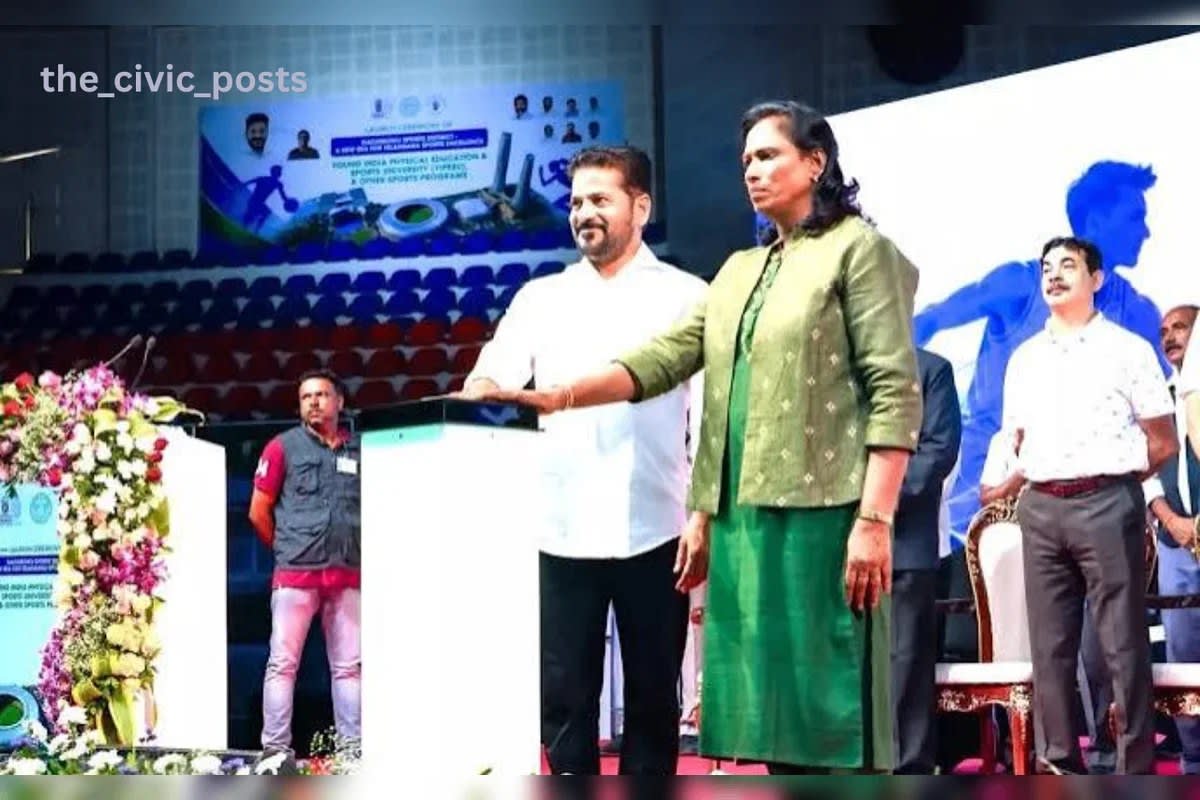
The landscape of Indian sports is undergoing a paradigm shift, and Telangana is actively positioning itself at the absolute forefront of this revolution. Telangana Chief Minister A. Revanth Reddy officially laid out an ambitious, multi-decade roadmap designed to transform the state into India's premier athletic epicenter.
Speaking at a highly anticipated event in Hyderabad, the Chief Minister revealed a dream that is as bold as it is challenging: if and when India secures the rights to host the Olympic Games in the near future, Hyderabad must be ready to serve as the ultimate host destination.
This visionary statement was not just a rhetorical ambition. It served as the anchor for a series of major institutional rollouts, including the inauguration of the Gachibowli Sports District and the official launch of the logo for the newly established Young India Physical Education and Sports University (YIPESU).
Flanked by Indian Olympic Association (IOA) President and legendary athlete P.T. Usha, Telangana Sports Minister Vakiti Srihari, and other key administrative figures, the Chief Minister made it clear that Telangana is moving away from ad-hoc sports management and moving toward a highly structured, scientifically backed sports policy.
For an international bid like the Olympics to be viable, infrastructure cannot just be adequate; it must be world-class. The anchoring of this new movement centers heavily on the reimagining of the Gachibowli area into a dedicated, state-of-the-art Sports District. Alongside it, the establishment of the Young India Physical Education and Sports University (YIPESU) marks a massive shift in how athletic talent is developed in India.
YIPESU is designed to be an elite, multifaceted institution rather than just a training facility. As IOA President P.T. Usha noted during the launch, the university aims to solve one of the greatest systemic gaps in Indian sports: the fragmentation of support systems. YIPESU will house several critical verticals under a single, unified umbrella, integrating elite coaching programs to standardize training methodologies across various sports disciplines.
It will also deploy cutting-edge sports science and analytics, implementing data-driven performance assessments to unlock human potential. Alongside this, comprehensive sports medicine programs will provide integrated rehabilitation, injury prevention, and physical therapy, while dedicated para sports infrastructure ensures adaptive athletes have identical access to top-tier training environments.
Furthermore, the institution will prioritize sports research and administration, actively training the next generation of referees, analysts, managers, and scouts who understand the global sports economy. By integrating these domains, Telangana is shifting the narrative from simply hoping to find natural talent to actively manufacturing athletic excellence through systemic support.
A core component of Chief Minister Revanth Reddy’s address was a frank, unvarnished critique of how athletic facilities have been treated historically. The Chief Minister pointed out a frustrating reality: over the past twenty years, Hyderabad has failed to organize major, high-profile international tournaments. Even more concerning was his observation regarding the state of existing infrastructure over the last decade.
He remarked that world-class facilities, built at immense public expense, had gradually devolved into venues for private commercial entertainment events and wedding celebrations. This misuse highlights a broader, nationwide issue. India has historically struggled at international forums like the Olympics not due to a lack of raw human potential, but due to the absence of a cohesive, long-term sports policy that treats sports as a core pillar of development.
When sports complexes are viewed as real estate to be rented out for events rather than high-performance training hubs, the entire athletic pipeline rusts. The revitalization of the Gachibowli Sports District signals an end to this commercial distraction, reclaiming these spaces strictly for athletic development and competitive excellence.
Recognizing that elite facilities in the state capital are meaningless if rural and semi-urban talents cannot access them, the Telangana government launched a unique outreach campaign called Telangana Sports Knowledge on Wheels. This mobile initiative is designed to travel across the length and breadth of the state, taking knowledge of sports science, proper nutrition, modern training regimens, and career opportunities directly to the doorsteps of schools and village grounds.
By deploying mobile knowledge hubs, the government aims to de-mystify professional sports for rural families, identify raw talent early, and educate local physical education teachers on modern, scientific training techniques. It effectively bridges the massive gap between rural potential and urban infrastructure, ensuring that no talented child is left behind simply because of their geographical location.
Ambition requires a timeline, and talent requires security. To ensure this sports policy bears fruit, the Chief Minister outlined a strict timeline and a robust safety net for athletes. A major milestone in this roadmap is the official establishment of the Telangana Sports Academy, set to be fully operational by December 2028. This academy will serve as the primary feeding pipeline into the YIPESU system.
Furthermore, the government is tackling the economic anxieties that frequently drive young Indians away from professional sports. To incentivize generational excellence, the state has committed to direct cash incentives, providing significant financial packages to athletes who bring glory to the state and country at national and international levels. Additionally, they are offering assured government employment, guaranteeing secure, high-ranking positions for medal-winning athletes and outstanding competitors.
This structural support directly addresses the classic dilemma faced by young athletes: the fear of financial instability once their competitive years are over. By guaranteeing that hard work and podium finishes translate into long-term career security, the state is encouraging families to support their children's athletic dreams fully.
The event also emphasized the cultural shift required to build an Olympic-grade nation. Reflecting on the journey of P.T. Usha-who rose from humble beginnings to become the face of Indian athletics and eventually a Member of Parliament in the Rajya Sabha-CM Revanth Reddy reminded young athletes that systemic infrastructure is only half the equation. The other half is absolute, uncompromising dedication, persistence, and hard work.
The presence of the IOA leadership at this launch signifies a strong alignment between state execution and national athletic management. For Hyderabad to legitimately bid for or host segments of a future Indian Olympic Games, this harmony between local governance and central sports bodies is absolutely critical. Transforming a city into an Olympic contender is an epic journey that demands billions in investment, flawless execution, and decades of sustained effort.
However, by treating sports as an academic, scientific, and economic discipline through YIPESU, Telangana is laying exactly the right foundation. By turning the focus away from commercial distractions and firmly toward world-class training halls, Hyderabad is taking its first confident strides toward making its ultimate Olympic dream a vibrant reality.