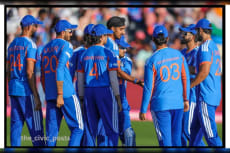
Harshit Rana Selection Sparks Fresh Debate Over India's Fitness Policy
Editorial desk - JUL 10, 2026

The selection policies of Indian cricket have long been a subject of intense public scrutiny, operating within an ecosystem where the path to the national side is traditionally viewed as an arduous grind. In a country teeming with exceptional bench strength, the standard protocol has historically demanded standout domestic performances, unrelenting consistency in the Indian Premier League, and an ironclad medical clearance from the National Cricket Academy.
However, when these established boundaries appear to bend for specific individuals, it invariably triggers a fierce debate regarding systemic fairness, athletic sustainability, and organizational transparency.
This exact conversation was reignited following blunt public remarks from former Indian opening batsman Sadagoppan Ramesh, who openly questioned the fast-tracked selection of young pacer Harshit Rana into the national squad without requiring him to validate his match fitness in competitive environments.
Harshit Rana’s rise as a fast bowler has undoubtedly been highly impressive, characterized by raw pace, an aggressive demeanor, and the ability to extract steep bounce from unresponsive tracks. He represents the exact profile of a modern fast bowler that Indian selectors crave, particularly for demanding overseas assignments where physical imposition is key. Yet, the critique leveled against his selection does not target his innate capabilities or his ceiling as an elite athlete; instead, it focuses squarely on the administrative framework governing his re-entry into high-intensity international fixtures.
Rana had recently undergone knee surgery, an intervention that inherently requires a meticulous, phased rehabilitation process to rebuild muscle volume, joint stability, and programmatic endurance. Rather than being eased back through a structured return-to-play pathway-such as playing localized domestic multi-day games or undergoing extended simulation camps-Rana was drafted directly back into the senior national setup.
This administrative impatience often backfires predictably due to the basic laws of human biomechanics. When an elite fast bowler returns to the crease before their kinetic chain is fully restored to maximum efficiency, the human body instinctively compensates for the lingering weakness. If a surgically repaired knee cannot absorb the immense ground reaction forces generated during a fast-bowling delivery stride, the surrounding muscle groups bear the brunt of the impact.
The result is a cascading vulnerability to secondary soft-tissue issues, specifically hamstring or quadriceps strains, which is exactly what unfolded in Rana's case. It provides clear evidence that entering an international series at less than optimum physical readiness invites structural failure.
The most concerning element of this situation is the perception that the team management employs different yardsticks for different players. For the better part of the last decade, Indian cricket prided itself on institutionalizing strict, non-negotiable fitness benchmarks.
The implementation of rigorous multi-stage fitness assessments established a clear precedent that no matter how talented or uniquely skilled a player was, failing to meet physical criteria meant immediate exclusion from the squad. When these boundaries blur for certain individuals, it sends a confusing and potentially demoralizing message through the domestic circuit.
Hundreds of cricketers toil in the Ranji Trophy, Vijay Hazare Trophy, and India 'A' tours, operating under the assumption that flawless fitness and structural durability are absolute prerequisites for national consideration. Seeing a player leapfrog these protocols can harm squad morale and diminish the perceived sanctity of the selection process.
A tactical contradiction further highlights the flaws in how the management handled Rana's workload. The decision to rest the young pacer for a concurrent tour of Zimbabwe indicates that the decision-makers were acutely aware that his body was incapable of enduring the physical stress of back-to-back series.
This raises a logical paradox: if a player is structurally compromised enough to require immediate insulation from certain tours, they should not be considered fit enough to spearhead the bowling attack in other high-stakes international matches. This erratic workload management suggests a reactive approach rather than a sustainable, long-term athletic strategy.
Injuries to fast bowlers are an occupational hazard, but when a squad carries players who are physically compromised, it forces an erratic, reactionary shuffling of the entire tactical lineup. A cricket team functions as an interconnected ecosystem; a vulnerability in the fast-bowling department immediately alters the equilibrium of the spin-bowling department and the overall tactical structure. This dynamic was fully visible during India's recent fixtures in England, culminating in a heavy nine-wicket defeat in Bristol.
The squad's structural balance was thrown into disarray by a separate, ill-timed injury to mystery spinner Varun Chakarvarthy. In a fully functioning system where fitness levels are predictable, tactical switches are seamless. However, Chakarvarthy’s sudden absence forced India to field Washington Sundar as their primary spin option. Sundar was drafted into the eleven despite the fact that the English batting lineup featured very few left-handers-a scenario where a conventional off-spinner typically yields less tactical leverage.
The insistence on playing Sundar over an attacking leg-spinner like Ravi Bishnoi exposed a deeper operational flaw: a distinct lack of institutional trust in Bishnoi's capabilities for these specific conditions. The mismanagement of physical health up top directly caused a compromise in tactical logic lower down the team sheet.
Defending the team's recent struggles, senior figures within the setup have offered a broader perspective on the squad's current trajectory, reminding fans and critics alike that the team is navigating an essential, often painful transition phase. Introducing a wave of young, inexperienced players to harsh, unfamiliar overseas conditions inherently involves a steep learning curve. From the team management’s perspective, these tactical missteps and structural errors are valuable teaching moments.
The speed at which young athletes adapt to foreign pitches, changing weather, and elite tactical opposition determines how quickly India can rebuild its overseas dominance. While a plea for patience is fair regarding tactical awareness and cricket intelligence, it cannot be used to excuse poor medical and selection oversight.
A young player can easily recover from a tactical mistake, like a poor shot selection or a bad bowling line. However, recovering from a preventable structural breakdown caused by rushed rehabilitation is far more difficult and can derail a promising career before it truly begins.
The controversy surrounding Harshit Rana's direct selection serves as a cautionary tale for the modern era of cricket management. In a sports ecosystem heavily influenced by franchise commitments and non-stop international schedules, protecting the physical well-being of young fast bowlers must take priority over short-term tactical goals. For the Indian team to achieve sustained success across all formats, the selection committee must return to a uniform, transparent set of fitness criteria.
True fairness means ensuring that every athlete-regardless of their star power, tournament pedigree, or unique skill set-passes through the exact same physical evaluation before being handed a national cap. Only by removing these varying standards can India protect its young talent, maintain high dressing-room morale, and build a resilient team capable of winning consistently on the world stage.