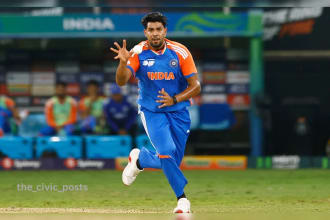
No Changes Needed: Ashwin’s Strong Stand on India’s Playing XI Sparks Debate
Editorial desk - JUL 9, 2026

The ongoing bilateral series between India and England has rapidly shifted from an exploratory phase for a transitioning Indian squad into a high-stakes rescue mission. Following an initial rain-affected match, the English side secured back-to-back dominant victories.
The lowest point for the visitors came at Trent Bridge, where the Indian batting line-up collapsed to a meager 76 runs, marking one of their most severe defeats by run margin in T20 International history. With the series on the line ahead of the crucial match in Bristol, the tactical framework deployed by head coach Gautam Gambhir and captain Shreyas Iyer has faced intense scrutiny from fans and analysts alike.
At the center of this public debate is the ongoing omission of wicketkeeper-batsman Sanju Samson, who was a significant part of India’s silverware-winning T20 World Cup squad earlier in the year. Instead, management has consistently given opportunities to fresh talent, including the exceptionally young Vaibhav Sooryavanshi.
While public sentiment strongly favors a sweeping overhaul to fix the batting woes, veteran off-spinner Ravichandran Ashwin offered a contrasting, highly analytical viewpoint on his personal analysis channel.
Ashwin publicly advocated for India to field an entirely unchanged playing eleven for the fourth match, despite acknowledging how difficult that decision would be for management. According to Ashwin, deploying the exact same squad that suffered the Nottingham collapse sends a message of structural confidence rather than panic.
He cricket-rationale stated that avoiding reactive changes is crucial to preventing a culture of fear from creeping into the locker room. In his view, when players see a peer dropped immediately after a collective failure, it breeds personal anxiety, making the remaining athletes play to survive rather than to win.
Ashwin noted that sticking with the current lineup would undeniably mean Samson sits on the bench yet again, describing such a choice by the coaching staff as a massive tactical call. However, he believes maintaining external and internal stability outweighs the immediate temptation to rely on a quick-fix substitution.
A core issue highlighted by cricket pundits during this tour is the stark transition young Indian batsmen must make when moving from domestic setups to international conditions. Ashwin admitted that he fully anticipated England’s dominance before the series even commenced. He drew parallels to an earlier series against Ireland, where the initial signs of vulnerability against the moving ball became apparent.
The root of the struggle lies in the fundamental difference between the pitches found in the Indian Premier League and the damp, seam-friendly surfaces of an English summer. In domestic franchise cricket, modern pitches are frequently optimized for high-scoring, true-bounce entertainment. Young batsmen develop a mechanical blueprint based on hand-eye coordination, trusting that the ball will consistently arrive at a predictable height without excessive lateral deviation.
When these same athletes are exposed to English pitches that offer sideways movement off the seam and swing through the air, that domestic blueprint falters. The lack of footwork and defensive discipline, traits less prioritized in standard T20 power-hitting, becomes an immediate liability. Ashwin emphasized that this specific group of young players lacks traditional red-ball exposure in overseas environments, meaning their growth curve will naturally be steep and painful.
The outcry for Sanju Samson is understandable given his proven ability to stabilize an innings and accelerate against spin. However, the management's current philosophy under Gautam Gambhir seems focused on a long-term cultural reset. If the selection committee chooses to cycle through players after every poor performance, they risk entering a continuous loop of short-term fixes without ever identifying who can genuinely handle pressure.
Furthermore, introducing a player like Samson into a fractured, low-confidence batting order puts immense pressure on that single individual to act as a savior. If the incoming player also struggles against high-quality English seam bowling, the team's overall morale suffers a double blow.
As India prepares for the fourth T20I, the coaching staff faces a philosophical crossroads. They can either capitulate to public pressure and reshuffle the top order, or they can adopt Ashwin's stoic approach by backing the young squad to figure out a solution on their own. International cricket rarely offers patient timelines, and a series loss in England is always heavily critiqued.
Yet, if India wants to build a squad capable of winning across all global conditions, enduring these harsh developmental periods without panicking might be the exact medicine this young team needs. The ultimate success of this approach won't just be measured by the scorecard in Bristol, but by how these specific batsmen adapt to swinging conditions over the next two to three years.