Uttam Kumar Reddy Holds BRS Responsible for Kaleshwaram's Structural Issues
Alekhya Kota - JUL 11, 2026
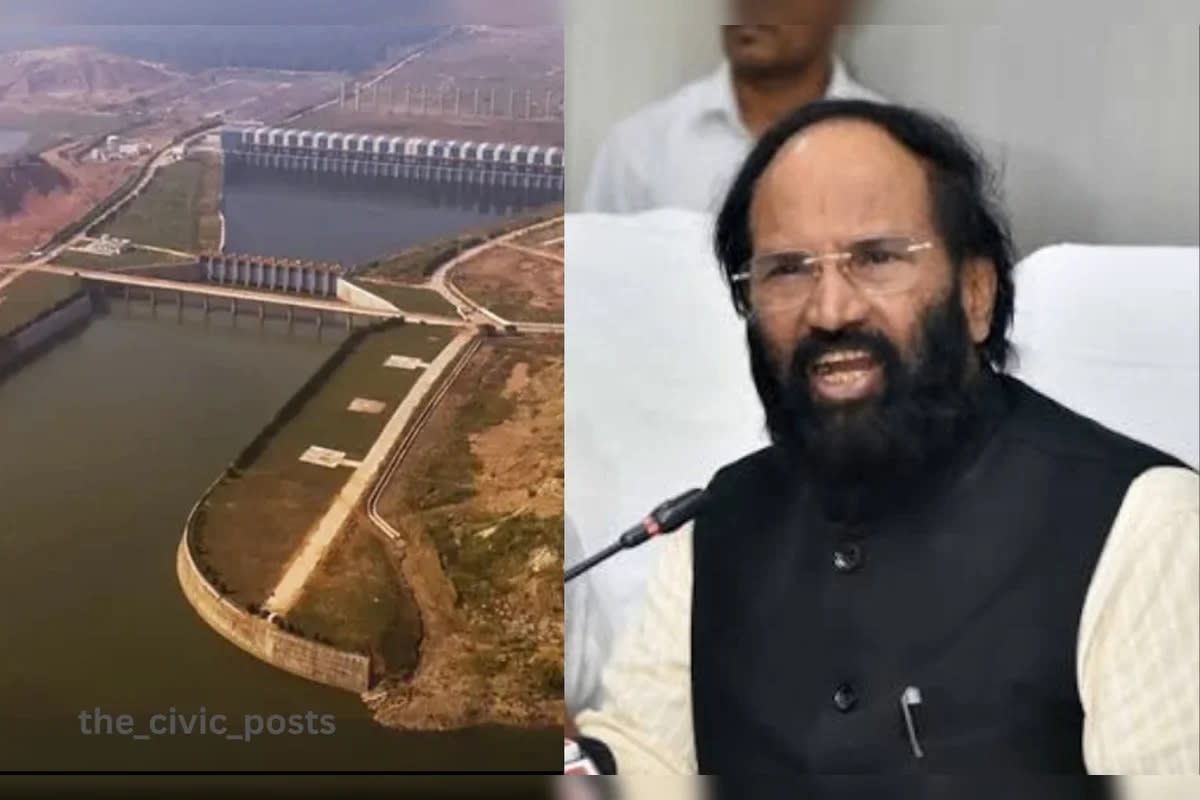
The debate surrounding macro-infrastructure accountability in India reached a critical turning point as Telangana’s Minister for Irrigation and Civil Supplies, N. Uttam Kumar Reddy, launched a fierce critique against the state’s former ruling party, the Bharat Rashtra Samithi. Speaking to media personnel during a press briefing in Huzurnagar, the Minister laid the blame for the severe structural vulnerabilities plaguing the multi-crore Kaleshwaram Lift Irrigation Scheme squarely at the doorstep of the previous administration.
Rather than treating the project's engineering issues as isolated accidents, the Minister framed them as the inevitable consequence of systemic corruption, poor construction quality, and reckless departures from approved engineering blueprints under the previous government.
The political friction took an unexpected turn when the Minister weaponized recent internal revelations to explain the project's underlying vulnerabilities. He pointed directly to a highly publicized statement made by BRS leader K. Kavitha-the daughter of former Chief Minister K. Chandrashekar Rao-who alleged that the party had received 1,400 crore rupees from contractors linked to the Kaleshwaram project. Uttam Kumar Reddy described this admission as the definitive "inside story" that exposes the real reasons behind the structural degradation of the infrastructure.
The Minister argued that when massive financial transactions occur on a quid pro quo basis between corporate executioners and political decision-makers, public safety, engineering standards, and basic material quality are completely sacrificed. He demanded that the BRS leadership provide an immediate and transparent explanation to the citizens of Telangana regarding this massive transfer of funds.
According to the state administration, this alleged contractor-politician nexus directly weakened independent bureaucratic oversight and allowed a culture of neglect to compromise the entire irrigation network.
The Minister noted that the physical manifestation of this compromise became undeniable with the partial collapse of the Medigadda barrage, alongside critical structural distress reporting at the interconnected Annaram and Sundilla barrages.
A review by the National Dam Safety Authority highlighted deep vulnerabilities, including compromised secant pile cut-off walls, extensive water seepage, and foundation piping-a dangerous process where eroding under-soil creates hollow voids beneath heavy concrete rafts.
At Medigadda's Block-7, this erosion caused severe settlement, rendering the structure highly unstable. The Minister emphasized that these structural flaws represent a broader, systemic failure to respect fundamental engineering principles during the initial construction phase.
A particularly striking revelation brought forward during the press conference involved major geographic deviations from the project's authorized planning blueprints.
The Minister alleged that two of the primary barrages within the Kaleshwaram chain were physically constructed nearly five kilometers away from the precise coordinates officially designated and approved in the original Detailed Project Report. Moving massive hydraulic structures several kilometers away from their studied locations represents an extraordinary engineering lapse.
Such a drastic shift should have required exhaustive, multi-phase geological, hydrological, and geotechnical surveys to ensure the new riverbed coordinates could support the intense weight and water pressure. Instead, the Minister asserted that these modifications were executed arbitrarily, fundamentally endangering the structural integrity of the entire reservoir network.
This baseline structural instability has created an ongoing standoff regarding the immediate management of the state's water resources. In the face of water scarcity and intense political pressure, BRS leaders have demanded that the current Congress-led government immediately activate the heavy lifting machinery at the Kannepalli pump house to impound incoming Godavari River water.
Uttam Kumar Reddy firmly rejected these demands, characterizing them as politically motivated and dangerously reckless. He explained the fluid dynamics of the system, noting that any water lifted from the main pump house would immediately rush into the Annaram barrage, pass through Sundilla, and flow deeper into the network.
Because the foundations of both the Annaram and Sundilla barrages are currently structurally compromised and under intense technical suspicion, filling them with millions of cusecs of heavy water without completing extensive rehabilitation could lead to a catastrophic breach, threatening downstream habitations and downstream areas like Bhadrachalam.
The Minister made it clear that the current administration will not participate in political games that put public safety at risk merely to create a superficial impression of operational functionality. To remedy the crisis, the Telangana government has put a complete halt to active water storage, keeping the barrages in a temporary "free-flow" condition while pursuing a rigorous, science-first roadmap.
Comprehensive technical investigations-including advanced geotechnical testing and Ground Penetrating Radar surveys to map underground hollows-are currently being finalized. The state is collaborating closely with premier national scientific institutions, including the National Dam Safety Authority, IIT Bombay, and the Central Water and Power Research Station, to draw up permanent engineering fixes.
The final rehabilitation blueprints are expected to be locked in by autumn, with physical reinforcement works scheduled to begin as soon as seasonal floodwaters recede late in the year. The administration aims to complete these extensive structural restorations by mid-2027.
The Minister also delivered a sharp critique of the financial burden left behind by the previous regime's infrastructure strategies. He stated that the BRS government spent approximately 1.81 lakh crore rupees on various irrigation initiatives, with a staggering 1.1 lakh crore rupees funneled directly into the Kaleshwaram scheme.
Despite this massive expenditure of public funds, the state has been left with an immense debt burden, while its primary engineering marvel remains structurally unsafe to hold water. He dismissed a public challenge from former Irrigation Minister T. Harish Rao, who claimed he could personally fix the Kaleshwaram project's defects within a three-month window if given control of the ministry.
Uttam Kumar Reddy labeled the proposal politically absurd, stating that the individuals who originally planned and oversaw the flawed execution should spend their time explaining their past actions to the public rather than demanding the keys to the ministry.
Looking toward long-term water security, the Telangana government is proactively designing alternative irrigation pathways to safeguard farming communities without relying on damaged infrastructure.
The state has initiated preliminary work on a long-term alternative designed to divert nearly 80 TMC of water from Tummidihatti purely through gravity, avoiding the heavy financial and mechanical costs of multi-stage lift systems.
A fresh Detailed Project Report has already been assigned to private engineering consultants, and formal diplomatic discussions are being initiated with the neighboring government of Maharashtra to secure necessary clearances for a new barrage construction at the Tummidihatti site.
Through this dual approach of rigorous, expert-certified rehabilitation of existing structures and the parallel development of gravity-fed alternatives, the state aims to repair a massive public infrastructure crisis while enforcing strict financial and engineering accountability.