Women's Free Bus Travel Scheme Gets a New Name in Tamil Nadu
Alekhya Kota - JUL 10, 2026
The political arena of Tamil Nadu has always been an environment where language, nomenclature, and iconography are heavily utilized as tools of statecraft and partisan identity. In a region where social welfare programs hold massive cultural and electoral significance, the branding of a state scheme is rarely treated as a minor administrative detail. Instead, it serves as a powerful statement of philosophical intent, an ideological signature, and a long-lasting claim over historical legacy.
This deep-seated tradition of semantic competition has recently re-emerged as a major focal point in regional governance. The newly established Tamilaga Vettri Kazhagam (TVK) administration, led by Chief Minister C. Joseph Vijay, executed a swift and highly discussed change to the visual and textual landscape of the state's transport network. By ordering the removal of a single, deeply symbolic word from the landmark free bus transit initiative for women, the current regime has ignited an intense statewide debate over policy ownership, bureaucratic pragmatism, and the subtle art of erasing a political opponent's public identity.
The epicenter of this dynamic administrative transition is located within the state’s massive public transport grid, specifically across the thousands of ordinary-fare, state-operated city buses that serve as the economic lifeline for millions of working-class families. Under the previous Dravida Munnetra Kazhagam (DMK) regime, which assumed office under the leadership of M.K. Stalin in May 2021, this flagship public subsidy was launched under the official title of Mahalir Vidiyal Payanam, translating conceptually to "The Journey toward Dawn for Women."
The specific inclusion of the word Vidiyal (Dawn) was far more than an inspired literary choice; it served as the core slogan, central campaign theme, and defining political identity of the DMK’s path to power. It was explicitly designed to project a fresh era of progressive societal awakening under their leadership.
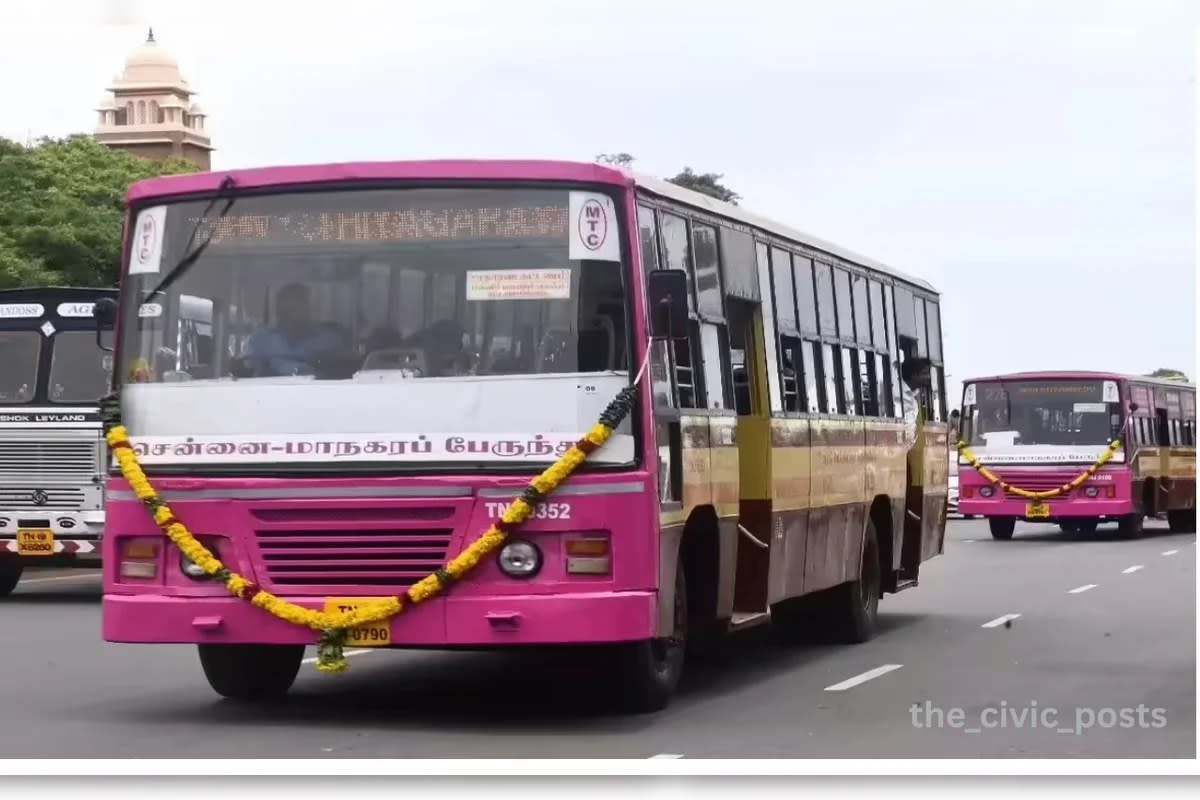
However, commuters waiting at bus terminals across Chennai and the wider landscape of Tamil Nadu witnessed a sudden transformation as transport vehicles rolled out of regional depots sporting freshly updated destination indicators. The digital and physical signboards had been stripped down to read simply Magalir Payanam (Women's Journey).
This quiet but total omission of Vidiyal stands as a classic case study in administrative de-branding. Senior transport authorities confirmed that direct, internal directives were sent down to branch managers and regional transport hubs across the state, instructing them to rapidly adjust the digital boards and physical signage across all eligible fleets.
Out of the roughly 9,000 metropolitan and regional city buses managed by the various State Transport Corporations, the free travel initiative blankets more than 7,300 ordinary-fare vehicles, traditionally distinguished by their white boards.
In the dense urban expanse of Chennai alone, where the Metropolitan Transport Corporation (MTC) operates 1,712 normal-fare buses, more than 1,500 vehicles are constantly utilized by women to access this vital socioeconomic benefit. The sweeping change across thousands of public vehicles overnight transformed an ongoing social service asset into a major political flashpoint.
The reaction from the displaced opposition was instantaneous, fierce, and structurally focused on the defense of political legacy. Taking to public communication channels, prominent DMK leader and former state minister Thangam Thennarasu delivered a highly critical, pointed assessment of the TVK government's maneuvering. He publicly asserted that while an incumbent administration possesses the logistical power to alter text on a physical bus board, it lacks the ability to rewrite actual history.
Thennarasu strongly argued that the Mahalir Vidiyal Payanam initiative was not a routine piece of bureaucratic paperwork, but a deeply transformative social intervention that had fundamentally altered the financial independence, workplace mobility, and personal autonomy of women throughout Tamil Nadu.
He maintained that the renaming exercise served no functional public interest, labeling it a transparent, politically motivated attempt to systematically dismantle the visible identity and historical credit belonging to the scheme's original architects.
The core of the opposition's critique touches upon an essential philosophy of governance: the idea that the true merit of a social welfare policy is judged entirely by its measurable impact on human lives rather than the vocabulary used to label it. From its launch in 2021 until the end of the first quarter of 2026, women across Tamil Nadu had completed a staggering 898 crore free trips under the scheme, with an estimated 60 lakh women utilizing the service every single day.
Data compiled by the State Planning Commission highlighted that the initiative allowed individual female commuters to save an average of ₹888 every single month-disposable income that was immediately redirected into household nutrition, children's education, and personal savings.
Critics argue that the institutional energy, administrative labor, and state resources required to alter software scripts, update central digital databases, and replace physical signage across thousands of vehicles would be far better spent on introducing new welfare programs, expanding the aging public transit fleet, or addressing the structural deficits within the transport corporations.
To understand the TVK government's perspective, one must look at the wider pattern of administrative rebranding that has rapidly unfolded since the new regime took charge. The renaming of the women's transit initiative is not an isolated incident; it follows a deliberate sequence of linguistic shifts targeting several prominent DMK-branded programs.
For instance, youth-centric empowerment programs like Nan Mudhalvan were previously updated to Thiran Tamil Nadu, while the Mudhalvar Padaipagam creative spaces were shortened to simply Padaipagam. When questioned by members of the press regarding the sudden disappearance of Vidiyal from state buses, Transport Minister Vijay Tamilan Parthiban maintained a guarded stance, stating simply that the program is Magalir Payanam and reassuring the public that the structural essence, funding, and operational availability of the free rides would remain completely untouched.
However, sources close to the transport administration suggest that this current linguistic stripping is merely a transitional phase ahead of a much larger, highly anticipated policy rollout. During the state assembly election campaigns, the TVK had explicitly promised in its manifesto to replace the existing system with a comprehensive model titled Vetri Payanam (Victory Journey).
Under this proposed framework, the free travel privilege would be expanded beyond ordinary white-board vehicles to cover all categories of government-run buses, effectively eliminating a frequent source of confusion and waiting times for female passengers at busy terminals.
By removing Vidiyal now, the administration effectively neutralizes the ongoing political advertising enjoyed by their rivals on thousands of rolling billboards across the state, clearing the visual canvas before introducing their own distinct branding.
Despite the intense political debates taking place within media circles and legislative halls, the day-to-day experience of the average commuter waiting on the platforms of Chennai remains entirely practical and transactional.
For the millions of women-including factory workers, domestic helpers, street vendors, students, and corporate employees-who line up at transit hubs every morning, the ideological nuances of the signboards are secondary to the operational reality of the service.
As long as the conductors accept their presence without fare demands and the buses run with consistent frequency, the political clash over whether the trip signifies "dawn" or "triumph" matters little to the immediate financial relief the program provides to household budgets. The absolute survival of the core subsidy, completely preserved through this linguistic transition, ensures that the vital economic safety net remains intact for the marginalized sections of society.
Ultimately, the renaming controversy highlights how deeply language, memory, and political power are woven into the fabric of regional governance in South India. It serves as a striking reminder that public transit buses are often treated as dynamic spaces for ideological messaging. As the newly updated Magalir Payanam boards become a standard feature of the state's geography, the entire episode leaves behind a broader philosophical lesson regarding political permanence.
An administration can use its legislative authority to repaint the symbols of the state and clear away the words of its predecessors, but the true authorship of a transformative social policy is rarely decided by official decrees alone. It remains permanently etched in the collective memory of the citizens whose daily lives were changed by its introduction.