“Cockroach Janata Party” (CJP): Satire, Youth Anger, and the Rise of Digital Political Resistance
Kranthi Vegesna - MAY 25, 2026
A Movement Born from a Remark
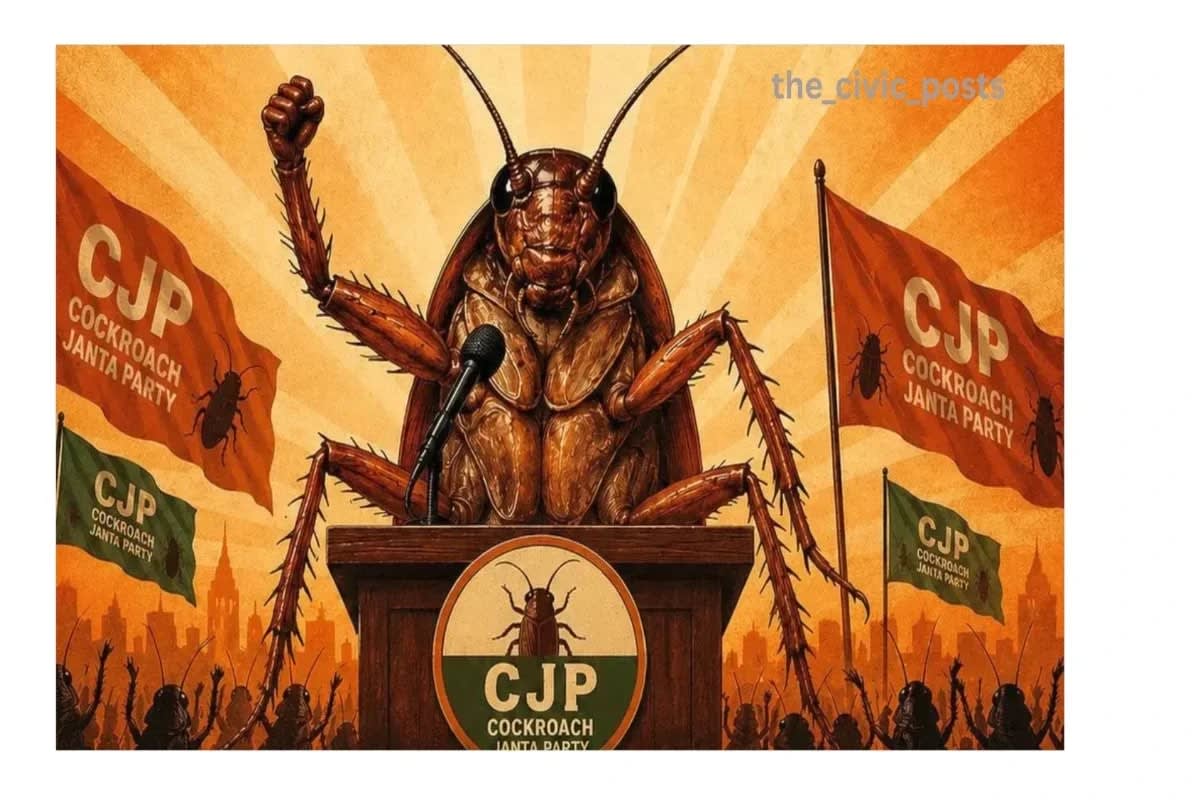
In May 2026, a hearing in the Supreme Court of India triggered a nationwide debate after comments reportedly made by Chief Justice Surya Kant went viral on social media. Claims that young people had been compared to “cockroaches” sparked outrage online, even though clarifications later followed.
By then, however, frustration among the youth had already found a symbol.
Seizing the moment, a young student abroad, Abhijeet Deepke, launched a satirical political movement called the “Cockroach Janata Party” (CJP). With the slogan “Main Bhi Cockroach” (“I Too Am a Cockroach”), many young Indians transformed what they viewed as an insult into a badge of resistance.
The underlying message was powerful: “If the system looks down on us, we will turn that contempt into strength.”
---
Youth Support: A Digital Rebellion
The biggest strength behind CJP’s rapid rise has been the support of India’s youth, particularly Gen-Z.
Many young people embraced the movement as an expression of their growing dissatisfaction with mainstream institutions and politics.
Why Did the Youth Connect with CJP?
Several factors contributed to its popularity:
Rising frustration over unemployment
Repeated paper leak scandals and corruption in government examinations
Declining trust in traditional political parties
The ability of social media to provide instant political participation and expression
Within days, CJP’s social media presence reportedly attracted massive engagement and millions of followers, becoming a warning sign for conventional political establishments.
---
A Protest Against Institutions
Although presented through satire and memes, CJP represents a deeper form of protest directed at two major institutions: the judiciary and the government.
1. Criticism of the Judiciary
Young supporters of the movement have raised concerns over:
Post-retirement political appointments for judges
Perceived political influence over judicial decisions
Lack of transparency within the judicial system
These concerns reflect a growing demand for institutional independence and accountability.
2. Dissatisfaction with the Government
The movement has also carried criticism directed at the government led by the Bharatiya Janata Party.
Key grievances include:
Rising unemployment
Failures in examination systems
Concerns over declining media independence
As a result, CJP has evolved into more than a meme campaign—it has become a digital protest platform for frustrated youth voices.
---
Manifesto Analysis: Serious Questions Behind the Satire
While many of CJP’s proposals appear humorous on the surface, the issues they raise are deeply political and constitutional.
1. No Rajya Sabha Seats for Retired Judges
Analysis
The movement argues that offering political positions to retired judges creates doubts about judicial independence.
Possible Impact
Greater public trust in the judiciary
Reduced perception of political influence over judgments
Challenges
Would require significant legal and constitutional reforms
---
2. Fifty Percent Reservation for Women
Analysis
Women constitute nearly half of India’s population, yet remain underrepresented in politics.
Possible Impact
Improved gender representation
Greater focus on women-centric policy issues
Challenges
Resistance from entrenched political interests within parties
---
3. Twenty-Year Ban on Political Defections
Analysis
This proposal highlights weaknesses in India’s current anti-defection laws.
Possible Impact
Stronger political ethics
Greater respect for voter mandates
Challenges
Would likely require constitutional amendments
---
4. Media Must Question Power
Analysis
A free and questioning media is central to democratic accountability.
Possible Impact
Increased scrutiny of governments
Better visibility for public issues and grievances
Challenges
Structural issues related to media ownership and influence
---
5. Protection of Voting Rights
Analysis
Electoral malpractice undermines democratic legitimacy.
Possible Impact
Freer and fairer elections
Stronger public confidence in democracy
Challenges
Requires strict monitoring and institutional enforcement
---
The Importance of Satirical Movements
History shows that satire has often played a major role in political awakening and reform movements. CJP may represent an early sign of a broader democratic shift.
Such movements can:
Encourage political awareness among young citizens
Expose institutional weaknesses
Create new forms of democratic conversation and participation
In the digital age, memes and satire are increasingly becoming political tools rather than mere entertainment.
---
What Lies Ahead for CJP?
The future of the movement could take two possible paths.
1. Remaining a Social Movement
CJP could continue as a decentralized online protest movement using memes, campaigns, and public pressure to shape political discourse.
2. Transforming into a Political Party
If formally registered with the Election Commission of India, the movement could eventually enter electoral politics.
Whether it succeeds electorally or not, its emergence already signals a growing disconnect between young citizens and established political institutions.
Revolution Through Satire
The “Cockroach Janata Party” is not merely a passing social media trend. It reflects a deeper sense of frustration among India’s youth and represents a new language of political resistance.
In a democracy, such movements serve an important role-they force institutions to remain alert, accountable, and responsive.
But the true value of CJP will depend on whether it remains only a symbolic protest or evolves into a force capable of contributing to meaningful structural change.
Satire can spark outrage.
Outrage can spark debate.
And sometimes, debate can spark reform.