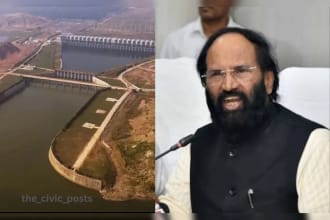
Dharani Portal Controversy: Telangana’s Digital Land Dream Faces a Reality Check
Alekhya Kota - JUL 8, 2026

In the age of digital governance, technology has become a symbol of progress and efficiency. Governments across the world are adopting online platforms to make public services faster, simpler, and more transparent. India too has embraced this transformation, with several states moving towards digital systems to reduce paperwork and improve accessibility.
Telangana’s Dharani portal was launched with a similar vision-to modernise land administration and provide citizens with a seamless digital experience for property-related services. The platform was expected to bring an end to traditional challenges such as delays, manual errors, and complicated procedures.
However, recent allegations surrounding illegal land transactions through the Dharani system have placed the platform under intense scrutiny. The controversy has created a larger debate about digital governance, accountability, data security, and the protection of citizens’ property rights.
The issue is not merely about a software platform. It is about the trust people place in government systems that manage one of their most valuable assets-land.
For many people, land is not simply a piece of property mentioned in official documents. It represents years of hard work, family history, financial security, and future stability.
A farmer’s agricultural land may be the foundation of an entire household’s income. A residential property may represent decades of savings. A family’s ownership rights depend heavily on accurate government records.
Because of this emotional and economic importance, even a minor error in land records can create serious consequences. Incorrect ownership details, unauthorised changes, or unclear transaction histories can lead to disputes that may continue for generations.
This makes land administration one of the most sensitive responsibilities of any government.
Before digital land systems became common, property-related services often involved lengthy procedures. Citizens had to depend on physical records, visit multiple offices, and deal with delays in updating information.
The Dharani portal was introduced as an attempt to change this experience. By bringing land records and transactions into a digital environment, the system aimed to make services more efficient and reduce unnecessary complications.
The expected benefits were significant:
* Faster access to land information.
* Reduction in paperwork.
* Better monitoring of transactions.
* Less dependence on manual processes.
* Greater transparency in administration.
The idea behind digitisation was simple: when information becomes organised and accessible, governance becomes more effective.
While technology can improve governance, it cannot automatically eliminate every problem. A digital platform is only as reliable as the information entered into it and the procedures followed behind it.
The allegations related to Dharani have raised concerns about whether certain transactions may have bypassed proper verification processes or whether weaknesses in the system were exploited.
Investigations into such matters are important because they help determine what actually happened. At the same time, they also highlight the need for stronger safeguards in every digital governance project.
A modern system requires more than advanced technology. It needs transparency, accountability, and continuous supervision.
In today’s digital world, data security has become a major concern. Government platforms store large amounts of sensitive information, and protecting such data is essential.
A land record system must ensure that every activity is traceable. Any modification, approval, or transaction should have a clear digital record showing who initiated it and who authorised it.
Strong cybersecurity measures, regular audits, and independent monitoring are necessary to prevent misuse.
Digital transformation should create confidence among citizens, not uncertainty.
Large administrative controversies often appear to be discussions between governments, officials, and political parties. But the real impact is felt by ordinary citizens.
A person whose land record contains an error may face difficulties obtaining loans, transferring ownership, or proving legal rights. Farmers and small landowners are especially vulnerable because they often depend completely on their property for financial security.
Therefore, resolving issues related to digital land records requires sensitivity and fairness.
The objective should not only be identifying mistakes but also ensuring that genuine property owners are protected.
Technology is often praised for bringing transparency, but transparency becomes meaningful only when accountability exists.
If a digital system records every action, there must also be a mechanism to examine those actions when irregularities occur.
Officials responsible for managing public platforms must follow strict procedures. Any misuse of authority should result in appropriate action.
At the same time, innocent individuals should not suffer because of administrative failures.
A balanced approach is necessary-one that protects citizens while ensuring responsibility.
Land-related issues naturally attract political attention because of their economic and social importance. Different political groups may interpret the situation in different ways.
However, the long-term solution should not be limited to political arguments. What citizens need is a transparent investigation, corrective measures, and a stronger system.
Public institutions gain credibility when they acknowledge problems and work towards improvement.
The focus should remain on strengthening land governance rather than only assigning blame.
The Dharani controversy offers valuable lessons for India’s broader digital transformation journey.
As more government services move online, citizens will increasingly depend on digital platforms for essential needs. Whether it is property records, healthcare information, or financial services, accuracy and security will become more important than ever.
Digital governance should follow three important principles:
Accessibility: Citizens should be able to use services easily.
Security: Personal and official information must remain protected.
Accountability: Every action within the system must have responsible ownership.
Only when these three elements work together can technology truly serve society.
The present situation can also become an opportunity to improve Telangana’s land administration system. Instead of viewing technology as a failure, authorities can focus on making the system stronger.
Regular audits, improved verification methods, better grievance mechanisms, and greater public awareness can help rebuild confidence.
A successful digital platform is not one that never faces challenges. It is one that learns from challenges and becomes better over time.
The Dharani portal represents both the possibilities and challenges of digital governance. It shows how technology can simplify administration while also reminding us that digital systems require constant attention and responsibility.
The ultimate goal of any government technology initiative should be to protect citizens’ interests and make their lives easier.
For Telangana, the current challenge is not just about investigating alleged irregularities. It is about ensuring that every citizen believes their land rights are safe in the digital era.
Technology can change the way governments function, but trust remains the foundation of good governance. A truly successful digital future will be one where innovation and accountability move together.