Rayalaseema Set for Industrial Revolution as JSW Launches Mega Steel Plant
Alekhya Kota - JUL 3, 2026

The industrial landscape of the Rayalaseema region in Andhra Pradesh took a monumental leap forward on July 3, 2026, as Chief Minister N. Chandrababu Naidu officially inaugurated the full-scale construction of the JSW Rayalaseema Integrated Steel Plant.
Situated across the villages of Sunnapurallapalli and Peddadanluru within the Jammalamadugu mandal of YSR Kadapa district, this expansive heavy manufacturing initiative marks the end of nearly two decades of administrative delays and repeated ceremonial delays.
Spearheaded by JSW Andhra Pradesh Steel Limited, a wholly-owned subsidiary of the prominent steelmaking conglomerate JSW Steel, the mega project represents a total capital commitment of sixteen thousand three hundred and fifty crore rupees.
By shifting the venture from a theoretical proposal into concrete, active field execution, the state administration aims to stimulate widespread economic rejuvenation across a geography historically burdened by geographic isolation, drought, and low industrial employment.
The immense financial and structural roadmap of this manufacturing hub is designed to roll out in two distinct, sequential development phases to maximize resource allocation and streamline factory scaling.
The initial phase is backed by an immediate capital layout of four thousand five hundred crore rupees, dedicated to establishing the core foundational setup and achieving an early output capacity of one million tonnes per annum.
This opening operational stretch is anticipated to provide approximately one thousand direct technical and manufacturing jobs for local engineering talent. Following the successful stabilization of the initial facility, the second expansion phase will bring in an additional investment of eleven thousand eight hundred and fifty crore rupees.
This second deployment will double the total output ceiling to two million tonnes per annum while creating an estimated fifteen hundred extra direct employment slots. The combined production target aims to have the integrated facility spinning up its heavy machinery for full commercial operations by March 2028.
A defining characteristic that sets the JSW Rayalaseema project apart from older industrial facilities across the country is its absolute commitment to ecological modernism and carbon mitigation.
Rather than adopting the conventional, highly polluting coal-fired blast furnace architecture that has dominated the global metallurgical sector for decades, the Kadapa facility is meticulously engineered as a state-of-the-art green steel factory. The plant will utilize advanced, scrap-based Electric Arc Furnace technology alongside high-grade direct reduced iron as its primary material inputs.
This advanced manufacturing framework will be run entirely on sustainable, renewable energy sources, radically shrinking the factory’s overall carbon footprint and aligning the state’s industrial ambitions with modern environmental standards.
The launch of real construction brings a sense of closure to a long, nineteen-year political journey that involved multiple administrative shifts and five separate foundation-laying ceremonies under three different regional leaders without achieving any actual progress beyond the ceremonial stage.
The complex history of the site originally began in June 2007 when then-Chief Minister Y.S. Rajasekhara Reddy launched the ill-fated Brahmani Steels project, which eventually collapsed due to illegal mining controversies and subsequent anti-corruption investigations, resulting in the total cancellation of its massive ten thousand acre land allotment.
Following the state's bifurcation in 2014, widespread public protests and long hunger strikes demanding a public-sector steel plant failed to secure action from the central government. This prompted the state to look toward private partnerships, leading to subsequent foundation ceremonies in late 2018 under the previous tenure of the current Chief Minister, and again in early 2023 under the former administration, which had designated the site under the YSR Steel Corporation banner.
The project had slowed down significantly due to delayed contractor payments and lingering policy issues, but the current coalition government broke the gridlock through the fast-tracked issuance of Government Order Number 131, which smoothly transferred all prior environmental and statutory clearances directly to JSW, cleared outstanding debts, and locked in the necessary eleven hundred acres of land at a standardized rate of five lakh rupees per acre.
To ensure that the massive complex is capable of meeting its ambitious 2028 operational deadline, the state administration has simultaneously mobilized massive engineering works to construct vital external supporting infrastructure around the Jammalamadugu corridor.
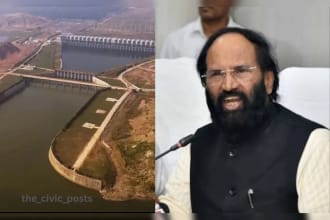
To handle the high water volume required for cooling and industrial processing, the government has guaranteed a dedicated allocation of two thousand million cubic feet of water sourced directly from the nearby Gandikota reservoir. Furthermore, the power grid is undergoing heavy reinforcement, with a massive two hundred and sixty-eight megawatt electrical feed being directed down to the plant site from the local Jammalamadugu power substation.
On the logistical front, heavy transport access is being secured through a dedicated road connectivity project linking the factory directly to National Highway 67, while a specialized twelve-kilometer industrial railway line connecting the internal logistics yard to the Muddanuru Railway Station is being aggressively built through the technical expertise of RITES under the federal PM Gati Shakti framework.
Addressing a large public gathering following the ground-breaking ceremony, Chief Minister Naidu framed the arrival of the JSW plant as a turning point that will fundamentally reshape the socio-economic identity of Rayalaseema, charting a new path forward from its historical struggles with factional unrest and structural underdevelopment.
The administration envisions this facility acting as a powerful economic anchor that will naturally draw in a dense network of downstream processing units, ancillary engineering suppliers, and logistical support businesses throughout Kadapa and neighboring areas. By embedding a sustainable, heavy industrial presence alongside the region's existing strengths in high-value horticulture and rich mineral extraction, the state aims to build a highly diversified, resilient local economy.
Ultimately, the primary goal of this industrial push is to create thousands of stable, long-term employment opportunities within the state, giving the local youth the chance to build meaningful careers at home instead of being forced to migrate to distant urban hubs in neighboring states in search of work.